Est. 1885 · Teller County Pioneer History · Florissant Settlement History
Florissant sits at roughly 8,000 feet in Teller County, Colorado, tucked between the Pikes Peak massif and the high meadows that descend toward South Park. The town's name derives from the French for 'flowering' — an apt description for the high valley's short but vivid growing season. Settlement here was rooted in ranching and, later, tourism tied to the fossil beds now preserved as Florissant Fossil Beds National Monument.
The Castello family settled in the area in the latter half of the 19th century. Judge James Castello — for whom the surrounding town of Florissant was effectively named — died in 1878 and is buried in the Florissant Cemetery; he never lived in the current building, which the McLaughlin family did not erect on this corner until 1885. The property at what is now US Highway 24 is identified as the 1885 McLaughlin House, and local tradition holds that James's widow Catherine later died in the home from a domestic accident when her dress caught fire and the burns proved fatal. Their son Frank and his wife had children who also died in Florissant while young.
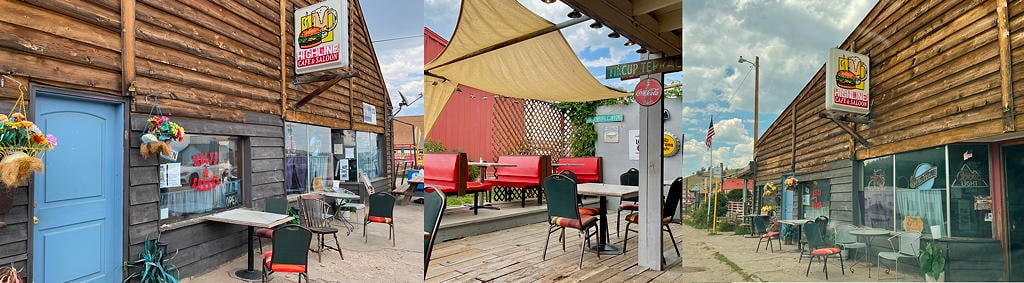
The building transitioned from residential to commercial use and is now operated as the Costello Coffee House. The current owner has preserved much of the original structure, including the upper floor. The building's heritage page on the coffee house website documents the family history.
The coffee house is among the more accessible 'actively operating haunted business' experiences in the Colorado Springs day-trip range — it is a functioning restaurant with verifiable hours, confirmed by Yelp reviews through November 2025.
Phantom footstepsCold spotsObject movementLights flickeringApparitions
The musical moose is the detail that sticks. It is a holiday decoration — the kind with a motion sensor or button that triggers a song. Staff placed it out, as they do every holiday season. On at least five separate occasions, it has begun playing with no one near it. Not once. Five times, in different years, noted by different employees.
The upstairs is always cold. Not cold relative to the season — cold despite the heating system being on, cold in a way the rest of the building is not. Employees who work closing shifts report the upper floor as reliably several degrees below the downstairs dining area regardless of the thermostat.
The footsteps are audible from below. When the coffee house is closed and only one person is present downstairs, movement has been heard across the upper floor boards. It stops when investigated. It resumes.
The photograph is perhaps the most arresting artifact: the owner has a photo of a child sitting on the upstairs bathtub. The child was not in the room when the picture was taken. No one who has examined the photograph has offered an explanation that satisfies everyone who has seen it.
Objects don't stay where they're left. This is the employees' most commonly cited complaint — not frightening, exactly, just relentless. Things are never in the same place twice. Given the history of the property — Catherine Castello's reported fatal fire accident and the early deaths of grandchildren in the family's Florissant years — the question of which of the Castellos is responsible for the reorganization is one the staff has mostly stopped asking.