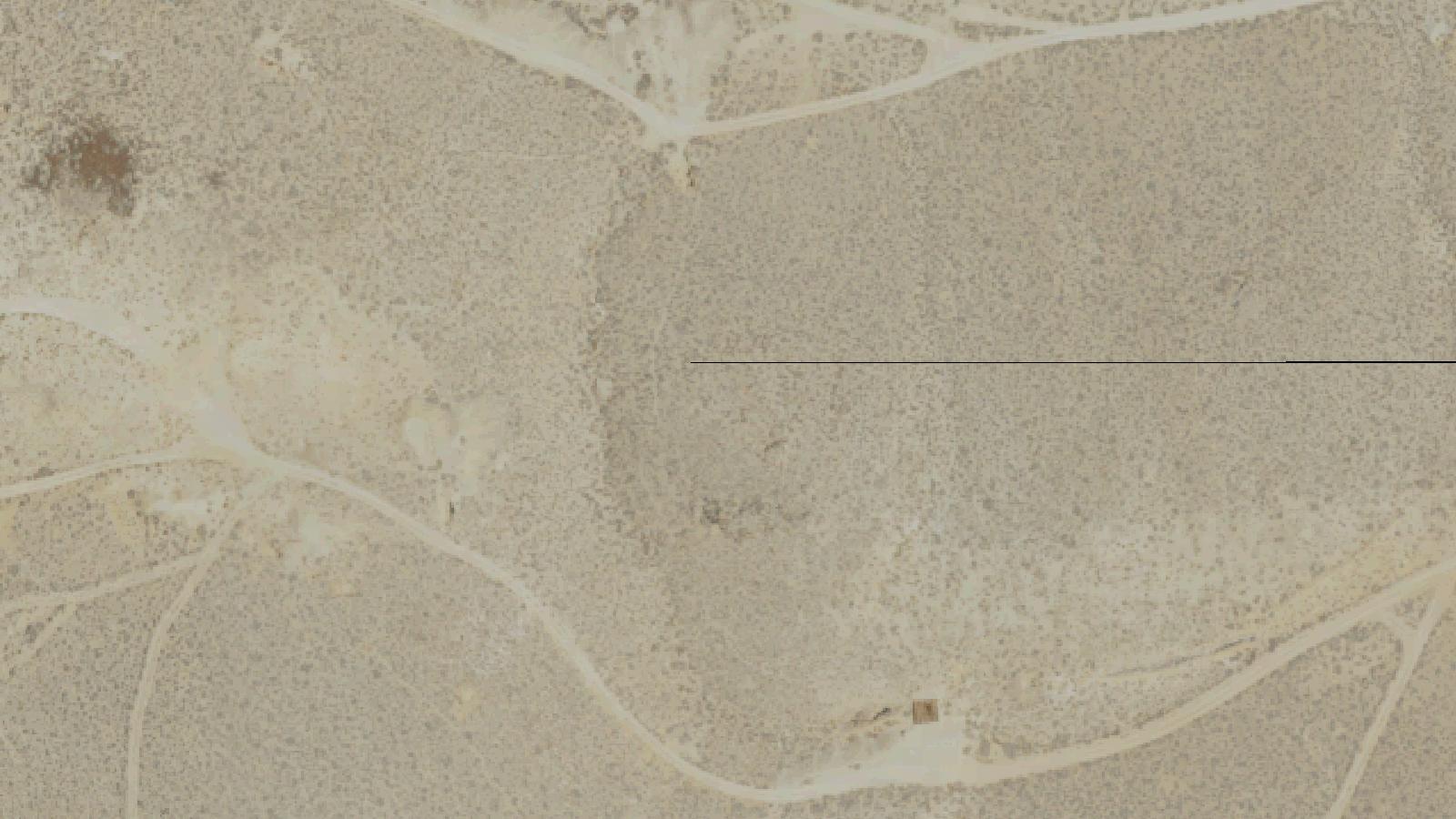
Est. 1906 · National Register of Historic Places (1974) · Death Valley National Park Historic District · Only documented lynching in Death Valley history · Location filming for Erich von Stroheim's Greed (1923)
Skidoo's name derives from '23 skidoo,' the slang expression of the period, tied to the number 23 through various theories involving the mine's original claim count and the length of its water pipeline. John Ramsey and 'One-Eye' Thompson discovered gold near Emigrant Spring in early 1906 while passing through on their way to a strike at Harrisburg. Bob Montgomery purchased their claims and began milling operations.
By March 1907 the town had 400-500 residents and growing. By April it had 130 buildings, a physician, lawyers, a telephone line to Rhyolite, a newspaper called the Skidoo News, and a bank. Its most remarkable infrastructure achievement was an 18-mile gravity-fed pipeline from Birch Spring near Telescope Peak, completed in November 1907 at a cost of $250,000. The pipeline dropped 1,800 feet in elevation, generating enough hydraulic force to power the stamp mill without a steam plant. At its 1907 peak the town had approximately 700 residents. The mine produced roughly 75,000 ounces of gold worth over $1.5 million before the rich vein played out in September 1917.
On the night of April 22, 1908, saloon keeper Joseph Simpson — known as 'Hootch' — murdered Jim Arnold, a well-regarded Trading Company owner who also handled mine payroll. Arnold was shot in broad daylight. Deputies arrested Simpson, but that night an angry mob overpowered the jail, dragged Simpson to a telephone pole near the mill, and hanged him. His body was cut down and buried the next morning. When reporters arrived to photograph the event, accounts of the period claim locals exhumed the corpse and hanged it a second time. A local physician later removed Simpson's skull as a souvenir; the skull was never recovered. No one was ever arrested for the lynching.
The 1907 financial panic, limited milling capacity, and ore exhaustion led to gradual decline. By 1922 the town had one resident. In 1923, filmmaker Erich von Stroheim used the site for location shooting on 'Greed,' the first feature film shot in Death Valley. The site was listed on the National Register of Historic Places in 1974 as a 4,160-acre historic district within Death Valley National Park.
Sources
- https://en.wikipedia.org/wiki/Skidoo%2C_California
- https://digital-desert.com/death-valley-history/skidoo.html
- https://www.nps.gov/deva/learn/historyculture/death-valley-ghost-towns.htm
- https://www.legendsofamerica.com/ca-skidoo/
ApparitionsHeadless figure
The documented history of Skidoo's single lynching is already strange enough to read as fiction. Joseph Simpson was hanged by a mob, cut down, buried, dug up, and hanged a second time for photographs. A physician then removed his skull, which was boiled clean and kept — and ultimately lost. No one was ever charged.
The paranormal tradition that grew from this sequence is straightforward: the man whose body was desecrated most thoroughly in Death Valley history left a presence at the site. An old prospector's account — the earliest version on record — described a gaunt, headless man walking erratically through the ruins of the town as if searching for something. Subsequent accounts repeat the same figure. Visitors to the townsite have reported the headless figure specifically at the area near the mill and the telephone pole where the lynching took place.
The quality of the haunting claim is unusual for the genre: it follows directly from a physically documented desecration with a specific causal logic (the man whose skull was taken is looking for it). This does not make the reports verified, but it does make the narrative internally coherent and tied to the historical record in a way that distinguishes it from most ghost-town folklore.
Notable Entities
Joseph 'Hootch' Simpson
Where this legend is told