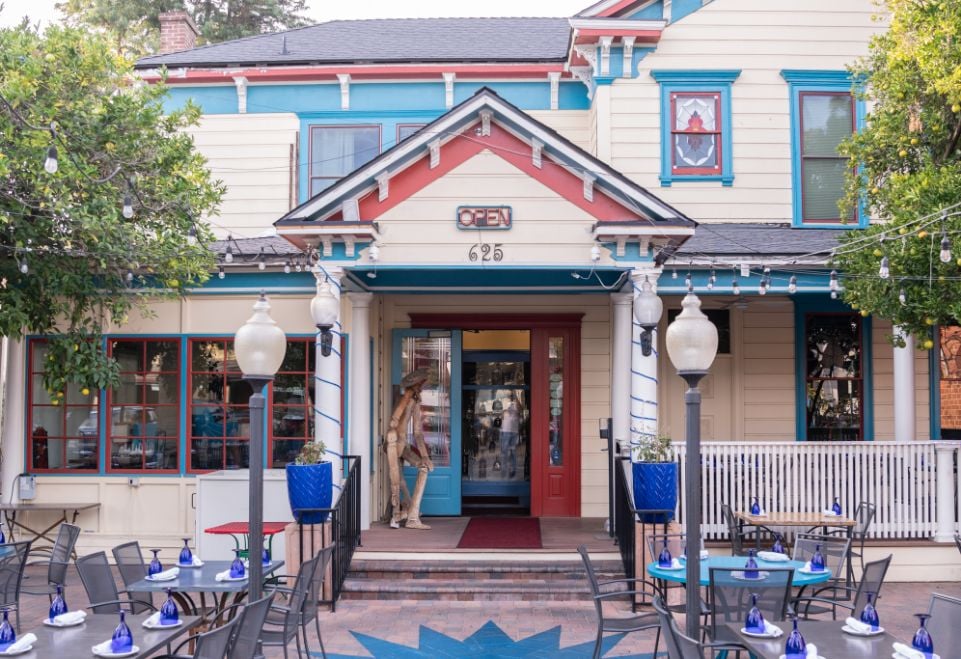
Est. 1848 · Claimed first two-story hotel built in California · 1848 boarding house for New Almaden quicksilver mine workers · New Almaden was the most productive mercury mine in North America · 175+ year continuous occupancy as hospitality structure
The New Almaden quicksilver mine opened in 1845, making it the first commercial mercury mine in North America. Mercury — called quicksilver — was essential to the gold and silver mining operations being developed across the West, and New Almaden became enormously valuable almost immediately. The mine attracted workers from Mexico, Chile, England, Wales, Cornwall, and China, creating one of the most ethnically diverse industrial communities in pre-Civil War California.
The boarding house at Bertram Road was constructed in 1848 to house the growing workforce. La Forêt's historical materials identify it as the first two-story hotel built in California — a claim that reflects the building's early date relative to California's European American settlement, which was still extremely thin in 1848. The structure was built beside Guadalupe Creek, with water access essential for both workers and the mining operation.
The mine operated continuously as a major mercury producer through the late 19th century, peaking in importance during the California Gold Rush when demand for mercury (used in gold amalgamation) was highest. At its peak, the New Almaden operation employed more than 1,800 workers. The boomtown it sustained — including residential areas, churches, schools, and boarding facilities like the Bertram Road building — was one of the larger industrial communities in the region.
As mining declined, the building transitioned through commercial uses. It operated as the Café del Rio during the 1930s and became La Forêt in the 1970s under the current restaurant's identity. The French fine dining format has remained consistent since, and La Forêt has built a reputation as one of the more distinctive dining destinations in the South Bay — in part because of the building's age and setting, in part because the food is genuinely good.
Sources
- https://www.laforetrestaurant.com/history
- https://www.kqed.org/news/12077572/new-almaden-the-mercury-mine-that-built-a-boomtown-south-of-san-jose
- https://www.foodgal.com/2017/12/san-joses-venerable-la-foret-gets-a-new-lease-on-life/
Unexplained soundsAtmospheric presenceCold spots
La Forêt's paranormal reputation is tied more to the cumulative weight of its history than to any specific documented event. The building has housed people continuously since 1848. The New Almaden mine it served was a dangerous operation: mercury mining produced occupational illness at high rates, and the boomtown it sustained saw the full range of violence, accident, and disease that characterized industrial frontier communities. The specific names and stories from the boarding house's early decades are not preserved in available historical record.
Visit San Jose's official tourism content and San Jose Spotlight have both identified La Forêt as a haunted San Jose location, reflecting the restaurant's standing in local paranormal lore. The accounts in circulation involve unexplained sounds, a sense of being watched or accompanied in the older sections of the building, and atmospheric disturbances without specific visual phenomena.
The building's setting — beside Guadalupe Creek, accessed by a rural road south of central San Jose, surrounded by the former New Almaden boomtown footprint — contributes to its atmospheric character. Dining at La Forêt in the evening, in a structure that predates the Civil War, with the creek audible and the Santa Cruz Mountains behind it, is an unusual experience in any terms. Whether the paranormal associations add to or merely reflect that atmosphere depends on the diner.
Where this legend is told