Est. 1918 · Tuberculosis Treatment History · United Farm Workers Movement · National Monument · California Labor History
The 116 acres now occupied by the Cesar E. Chavez National Monument were originally developed as a quarry in the early 1900s. After Kern County shut the quarry down in 1917, the California Bureau of Tuberculosis selected the site in 1918 for a new sanatorium - the Stony Brook Retreat. Over the next fifty years, Stony Brook expanded to include patient dormitories, a hospital, a small schoolhouse for child patients, garages, storage sheds, and administrative offices.
The sanatorium model - clean mountain air, sunshine, and isolation - was the standard treatment for tuberculosis until the introduction of streptomycin in 1943 and isoniazid in the 1950s rendered it unnecessary. Stony Brook closed in 1967.
In 1971 the United Farm Workers, led by Cesar Chavez, purchased the property and renamed it Nuestra Senora Reina de la Paz - Our Lady Queen of Peace, or simply La Paz. The site became the UFW's national headquarters, the home of Chavez and his wife Helen, and the location from which the union directed the grape and lettuce boycotts of the 1970s and 1980s.
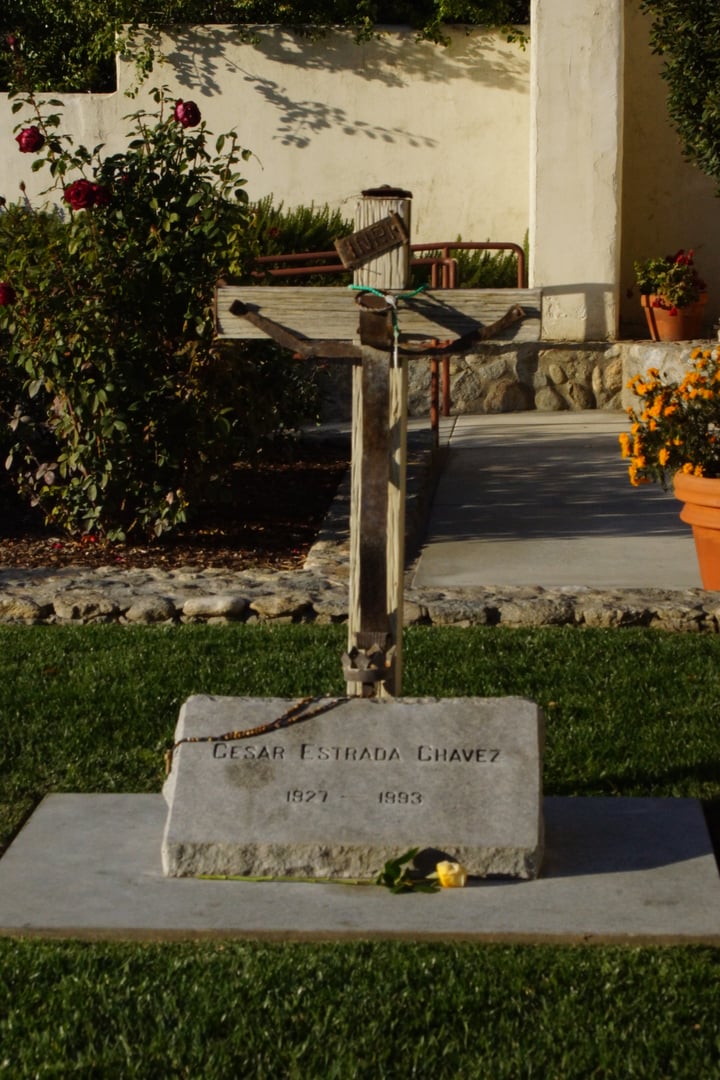
Chavez was buried at La Paz after his 1993 death. President Barack Obama designated 116 acres of the property the Cesar E. Chavez National Monument on October 8, 2012. The site is operated by the National Park Service and the Cesar Chavez Foundation. Several of the original sanatorium buildings remain in active use, repurposed for visitor center, exhibit, and administrative functions.
Sources
- https://en.wikipedia.org/wiki/C%C3%A9sar_E._Ch%C3%A1vez_National_Monument
- https://www.nps.gov/places/000/dormitory-and-former-tuberculosis-sanatorium.htm
- https://www.kvpr.org/podcast/central-valley-roots/2025-08-05/why-tuberculosis-sanitariums-once-dotted-the-foothills-of-the-central-valley
- https://abandonedusa.wordpress.com/2024/03/04/abandoned-mental-hospital-in-keene-ca/
Disembodied laughterPhantom voices
The Shadowlands Index entry for Keene Hospital describes the laughter and conversation of children in the former TB ward and unspecified voices and noises throughout the rest of the building. The submission frames the property as an abandoned hospital reachable only via dirt roads.
This description matches the property as it existed during the long mid-century gap between the sanatorium's 1967 closure and active modern use. The site is no longer abandoned and has not been for over five decades. Since the United Farm Workers acquired the property in 1971 and especially since National Park Service designation in 2012, the campus has been continuously occupied. We located no recent paranormal investigation, NPS-acknowledged report, or visitor account that corroborates the original Shadowlands narrative.
The historical context - children treated for tuberculosis at the on-site schoolhouse over multiple decades - is documented and makes the original premise plausible at its time of writing. But the property visitors encounter today is a working national monument, not the abandoned hospital described in the legend.