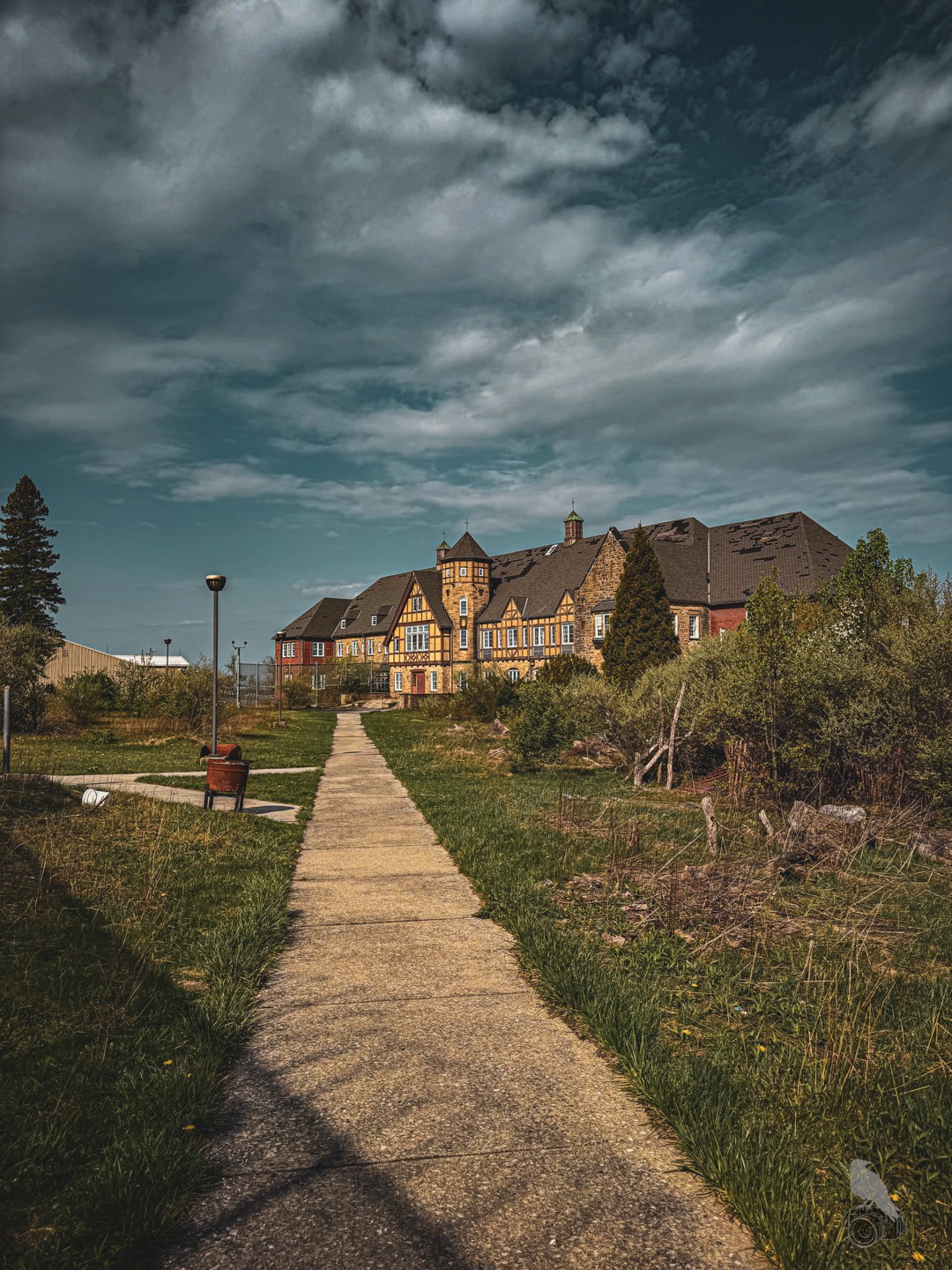
Est. 1851 · California's First Psychiatric Hospital · California Historical Landmark No. 1016 · Eugenics Program Site · Mass Grave Discovery 2005
California's gold rush produced not only fortune-seekers but a wave of social upheaval: men broken by failure, isolation, and the violence of mining camps. By 1851, the state legislature authorized the Insane Asylum of California at Stockton on 100 acres donated by Stockton founder Captain Charles Maria Weber. It was the first public psychiatric hospital on the Pacific Coast.
The first superintendent, Dr. Robert K. Reid, left under a cloud of documented misconduct. Investigators found that Reid had directed patients to build him a private residence on the grounds, farm crops that he then sold back to the institution, and falsified or omitted death records in his official reports. His removal did not end the abuses; the asylum struggled throughout the 19th century with overcrowding, inadequate staffing, and the same coercive practices that plagued state facilities nationally.
By the early 20th century, the hospital had become a site of California's broader eugenics program. Patients were subjected to forced sterilization regardless of diagnosis — the state ultimately sterilized roughly 20,000 Californians between 1909 and 1963, and Stockton contributed to that count. Lobotomies and electroshock therapy were performed through the mid-20th century.
When the facility finally closed between 1995 and 1996, California State University Stanislaus acquired the grounds for a Stockton branch campus. In 2005, construction workers uncovered a mass burial site on the property. Researchers estimated the remains represented more than 4,000 patients — most unidentified, buried without markers over more than a century of operation. The site is a California Historical Landmark, designated No. 1016.
Sources
- https://en.wikipedia.org/wiki/Stockton_State_Hospital
- https://scholarlycommons.pacific.edu/cgi/viewcontent.cgi?article=1066&context=libraries-articles
- https://oac.cdlib.org/findaid/ark:/13030/kt2r29r7mm/entire_text/
- https://www.uvm.edu/~lkaelber/eugenics/CA/CAold2.html
Unverified general reports
The campus operates as an active academic facility, which limits paranormal investigation access. What circulates instead is the gravity of the documented record: a mass grave holding at least 4,000 unidentified patients who died over 144 years of institutional confinement, now lying under a parking lot or lawn adjacent to lecture halls.
Local dark-tourism accounts note that 'one can only wonder' about the spirits of those confined here — a formulaic hedge that acknowledges the site's resonance without documenting specific phenomena. The more grounded accounts come from the CSU Stanislaus library, which has conducted periodic historic tours of the campus grounds, walking participants through structures that survived from the asylum era.
The building footprint has changed substantially since 1996, but the original 100-acre institutional scale remains encoded in the campus layout. The California Historical Landmark marker identifies the site without memorializing its dead. The mass grave has not been marked as a burial ground in any public-facing way.
Where this legend is told