Est. 1848 · National Register of Historic Places (1971) · Likely Tucson's Oldest Standing Structure · Congress Hall Saloon — Territorial Legislature Site · Mexican Adobe to Anglo-Territorial Transition Architecture
Tucson's downtown core retains few structures from its pre-American-period. The Brown House at 40 W. Broadway is the oldest of them. Archaeological work and dendrochronology — tree-ring dating of the original roof vigas — places construction of the south wing in the late 1840s, before the Gadsden Purchase transferred the region to United States sovereignty in 1853. The vigas in the rear section date to approximately 1840, though these may have been reused from an earlier structure.
Charles Owen Brown arrived in Tucson in the late 1860s and built his position through commercial enterprise. He co-owned the Congress Hall Saloon with J.A. Rosselle — an establishment significant enough that Congress Street itself was renamed in its honor in 1869. He served on Tucson's first city council. His wife Clara acquired the Brown House property in 1870, when John Capron sold it to her directly, and the family made it their primary residence.
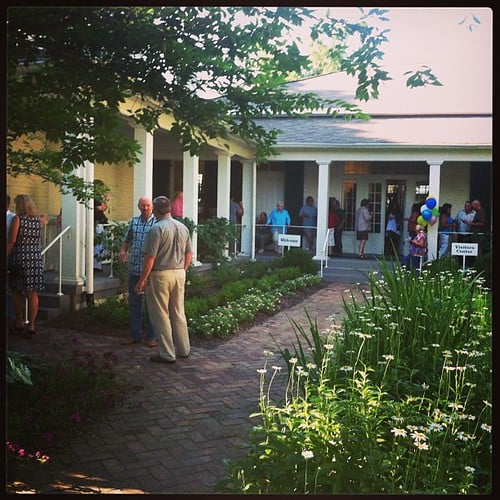
The south wing reflects the Mexican Adobe construction tradition of the pre-American period: thick walls, flat roof, minimal exterior ornament. The north house, added in 1876, adopted the Anglo-Territorial style then spreading through the Arizona Territory: pitched roof elements, more formal fenestration, a hybrid character that documented the transition between Tucson's two architectural eras.
Clara Brown outlived her husband and remained in the house until her death in 1932 at age 86. The property was added to the National Register of Historic Places on June 3, 1971. It is currently owned by the Arizona Historical Society. A renovation led by Ben's Bells included archaeological monitoring and data recovery by Desert Archaeology, Inc. Current tenants include Ben's Bells, Borderlands Theatre, and Riveted Home Goods.
Sources
- https://www.library.pima.gov/content/ghosts-in-tucson/
- https://localwiki.org/tucson/Charles_O._Brown_house_(The_Old_Adobe_Patio)
- https://desert.com/brown-house/
- https://en.wikipedia.org/wiki/Charles_Bolsius_House
Full-body apparitionPhysical unease in witnesses (hair-raise sensation)
The haunting report at the Charles O. Brown House is singular and consistent: a woman in a long dress, standing in the parking lot behind the building, who does not appear to belong to any living person. Reports have accumulated across multiple decades, attributed by local tradition to Clara Brown — the woman who acquired the property in 1870 and spent more than sixty years there before dying at age 86 in 1932.
The Pima County Public Library's survey of Tucson ghost accounts describes the figure as appearing in a Victorian-era gown and producing a distinct physical response in witnesses: the sensation of hair rising at the back of the neck. The figure does not interact with observers and does not move in ways that suggest a living person.
The Tucson Citizen newspaper independently documented the Clara Brown haunting, placing the apparition in the same location — the rear parking lot — and attributing it to the same identity. The consistency across independent sources, and across decades of reports from staff and visitors to the building's tenants, gives this account more grounding than typical single-source folklore.
The building's age — likely Tucson's oldest standing structure — and the continuity of Clara Brown's connection to it from 1870 to 1932 provide context for why this particular address generates persistent accounts rather than its neighbors.
Notable Entities
Clara Brown (woman in Victorian dress, rear parking lot)
Where this legend is told