Drive-By
Exterior Viewing on Riverside Avenue
View the 1910 Georgian Revival clubhouse from Riverside Avenue; the Cutter-designed facade and entrance medallions are visible from the public sidewalk.
- Duration:
- 15 min
HauntBound archive · catalog record
Reported phenomena, as catalogued
The city's premier private social club, founded 1890, in a 1910 Georgian Revival Kirtland Cutter building on Riverside Avenue; ghost lore is anchored in the 1914 disappearance of socialite member F. Lewis Clark.
1002 W Riverside Ave, Spokane, WA 99201
Research updated June 2026
Age
All Ages
Cost
$$$
Private membership club. The public can book a stay at the Spokane Club Hotel, and hotel guests can use the on-site 1910 Restaurant and Lounge.
Access
Wheelchair OK
Multi-story historic clubhouse; ground-floor public areas accessible to members and guests.
Equipment
No Photos
Est. 1910 · Founded 1890 as Spokane's first formal social club · 1910 Georgian Revival clubhouse designed by Kirtland Cutter · Contributing structure to the Riverside Avenue National Historic District · One of the continuously-operating Gilded Age city clubs in the Pacific Northwest
The Spokane Club was founded in 1890 as Spokane's first formal social and business club, serving the city's emerging mining, timber, and banking elite. After a fire damaged the upper floors of the club's previous building, the club commissioned Kirtland Cutter — already established as Spokane's pre-eminent Gilded Age architect — to design a new clubhouse at 1002 West Riverside Avenue.
The new building was completed in 1910 in the Georgian Revival style, with columned front entrance, decorative sun and medallion adornments above, and a refined institutional facade typical of Cutter's later commercial-civic work. The building houses dining rooms, bars, ballrooms, athletic and meeting facilities, and a small number of overnight hotel rooms for members and guests. It is a contributing structure to the Riverside Avenue National Historic District.
The club was originally male-only and remained so for much of the twentieth century; over time it has become a coed institution. The Spokane Club is one of a small handful of continuously operating Gilded Age city clubs in the Pacific Northwest and continues today as a private membership organization.
Sources
Frederick Lewis Clark (no relation to mining magnate Patrick 'Patsy' Clark) was a wealthy Spokane shipping, timber, and real-estate baron and a longtime member of the Spokane Club. On the evening of January 17, 1914, Clark and his wife Winifred arrived at the Santa Barbara, California train station. Clark put his wife on her train, kissed her goodbye, told his chauffeur to meet him in the morning, and set off on the boardwalk back to his hotel. He was never seen again. The next morning his hat was found on a beach near the wharf between the station and the hotel. Police ruled the disappearance a probable suicide and theorized that Clark had stepped into the sea to escape his failing health. His body was never recovered; the case remains formally unsolved and is documented in detail on the Wikipedia 'Disappearance of F. Lewis Clark' entry.
Per the Spokane Public Library walking-tour PDF and the Cinder Smoke ghost-tour writeup, members and guests at the Spokane Club have reported paranormal encounters in the bar, restaurant, ballrooms, and overnight rooms across decades, with the lore generally identifying the resident spirit as 'Lewis Clark' returning to the institution that anchored his Spokane life. Additional, less-specific lore describes long-time members reportedly 'still roaming the halls,' with some local sources speculating ties to the once-male-only character of the club.
Because ordinary club use is limited to members, the ghost reports are largely third-hand through ghost-tour and library walking-tour sources rather than from member or staff statements on the record. The historical anchor — F. Lewis Clark's well-documented 1914 disappearance — is unusually strong for a ghost story.
Notable Entities
View the 1910 Georgian Revival clubhouse from Riverside Avenue; the Cutter-designed facade and entrance medallions are visible from the public sidewalk.
Book a suite, boutique room or deluxe room at the Spokane Club Hotel, which welcomes members and guests. Hotel guests can use the on-site 1910 Restaurant and Lounge, barber shop, coworking studio and lockers with a sauna and steam room.
Some links on this page may earn HauntBound a small commission when you book, at no extra cost to you. Our editorial picks are independent. Full disclosure
Every HauntBound history is researched from documented sources. We clearly separate verified historical fact from paranormal folklore.
Free Guide
10 verified stops, rated for families, mapped in order. Free.
One email to confirm, then the guide link. Unsubscribe anytime.
Long Beach, WA
The Lamplighter Restaurant (also known as Rod's Lamplighter) was a long-running Long Beach Peninsula restaurant in Seaview, Washington. The building's mantle held the ashes of former owner Louis 'Louie' Sloan (1897–1977) and later those of subsequent former owner Lonnie Stanley (owner 1988–1992). The restaurant closed September 30, 2020, amid pandemic-era business losses.
Spokane, WA
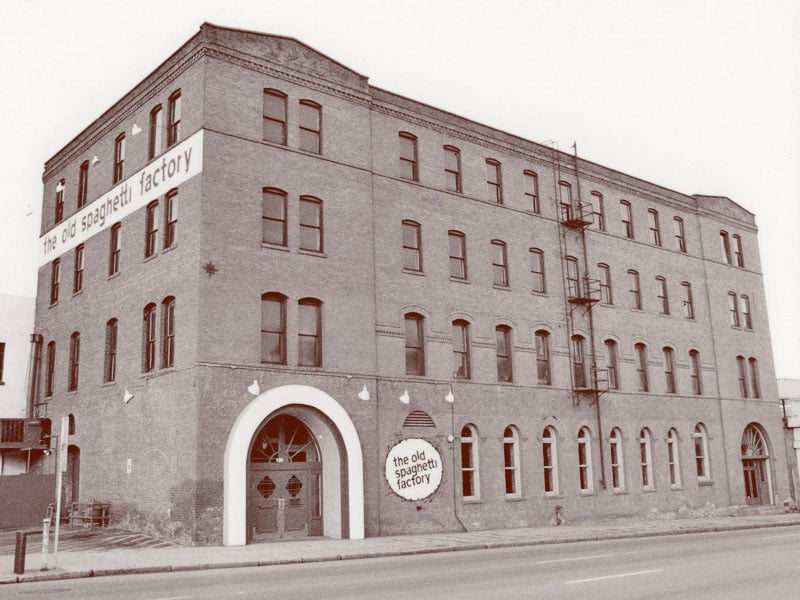
The 1890 brick warehouse was originally operated as a liquor warehouse, then as a grocery/mail-order warehouse. A documented historic tunnel connects the basement to the Davenport Hotel one block east. The building now houses Spokane's Old Spaghetti Factory restaurant location.
Great Falls, MT
The building at 518 Central Avenue in downtown Great Falls was built in 1914 by J.G. Anthony as the Davenport Hotel. Over the following century the upper floors operated as a hotel and, by local account, as a speakeasy and brothel during Prohibition; the building later housed the Jockey Club and the Lobby Bar, and in recent years has operated as The Wild Hare. A fire in November 1925 damaged part of the hotel and, according to local tradition, claimed at least one life.