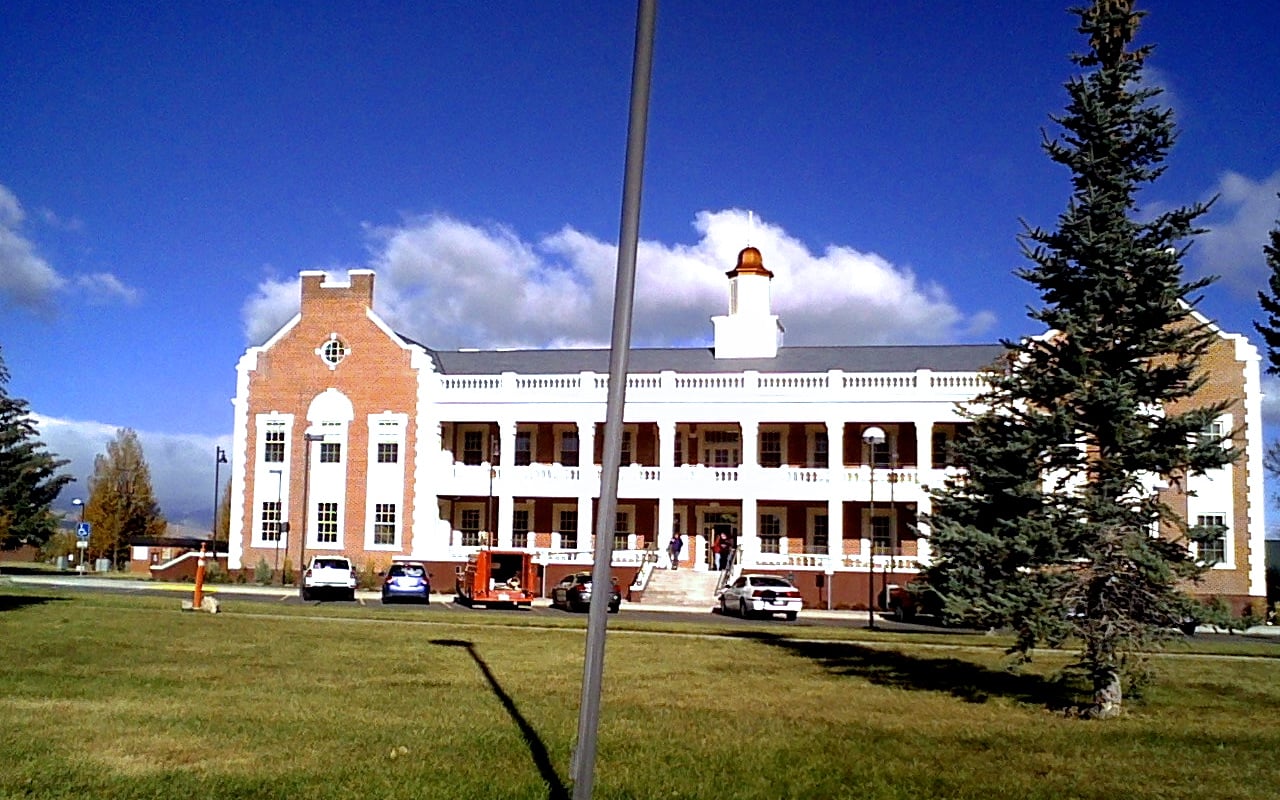
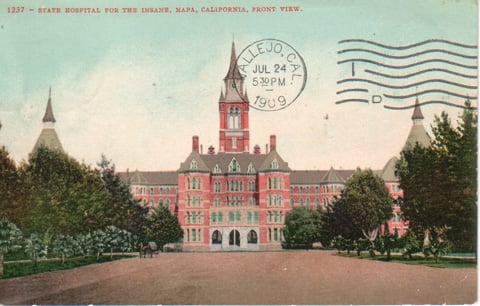
Est. 1891 · Opened 1891; peak census 1,728 patients in 1930s · Forced sterilizations conducted under eugenics superintendent Dr. Eugene Stanley · Severely damaged by Tropical Storm Irene, August 2011 · Repurposed as Waterbury State Office Complex, 2015 · National Register of Historic Places as Vermont State Hospital Historic District, 2016 · Unmarked patient burial grounds subject to K9 search and 2024 archaeological dig
The Vermont State Hospital for the Insane opened in Waterbury in 1891, built on a hillside campus in Washington County as the state's primary institution for the mentally ill. Through the late 19th and early 20th centuries, the campus expanded steadily; by the 1930s, it held approximately 1,728 patients, its peak census.
Under the superintendency of Dr. Eugene A. Stanley, the hospital participated in Vermont's organized eugenics program — one of the most formally developed in the northeastern United States. Forced sterilizations were performed on patients deemed unfit for reproduction, a practice carried out under state law that remained on the books into the mid-20th century.
The hospital's operations contracted through the deinstitutionalization era, though the campus remained operational for acute psychiatric care. In August 2011, Tropical Storm Irene flooded much of downtown Waterbury and severely damaged multiple hospital buildings. Rather than rebuild, the state relocated psychiatric services and converted the surviving structures into the Waterbury State Office Complex, completed in 2015. The historic campus was listed on the National Register of Historic Places in 2016 as the Vermont State Hospital Historic District.
Patients who died at the institution were buried in a cemetery in the surrounding woodland. The location and extent of that burial ground have been the subject of investigation: the Waterbury Historical Society documented K9 searches for the site, and in June 2024, an archaeological dig at a presumed cemetery location generated questions about the number and location of graves. The burial site has not been formally mapped or marked as of mid-2026.
Sources
- https://en.wikipedia.org/wiki/Vermont_State_Hospital
- https://www.waterburyhistoricalsociety.org/post/old-state-hospital-burial-grounds
- https://www.vermontpublic.org/local-news/2024-06-04/archeological-dig-at-presumed-vermont-state-hospiral-cemetery-psychiatric-hospital-burial-site-raises-questions
Unease associated with unmapped patient burial groundsGeneral atmospheric disturbance reported by visitors near wooded perimeter
Unlike many former asylum campuses where the paranormal reputation draws on vague institutional history, the dark pull of the Vermont State Hospital rests on a concrete, unresolved question: where exactly are the patients buried?
The hospital's patient cemetery was established somewhere on the wooded grounds surrounding the main campus, but its boundaries were never formally recorded, and the graves were not consistently marked. The Waterbury Historical Society documented canine search efforts to locate the burial area. In June 2024, an archaeological team conducted a dig at a presumed location, and Vermont Public Radio reported that the investigation raised more questions than it answered — including the possibility that remains may be scattered across a larger area than expected, or disturbed by the extensive campus construction and flood-related earthworks over 130 years.
The forced sterilization program conducted under Dr. Eugene Stanley adds a layer of institutional harm that makes the campus more than a deteriorated building. Patients who were sterilized against their will and then buried in an unmarked location represent a specific, documented injustice that has not been fully reckoned with. Accounts of unease at the campus tend to focus on this history rather than on named apparitions.
Where this legend is told