Self-Guided Visit
Drive-By / Exterior View
The mansion's ornate gingerbread trim, cantilevered Grand Hall entrance, and four-story tower are visible from Broadway. It is a private residence; no interior access.
- Duration:
- 15 min
HauntBound archive · catalog record
Reported phenomena — as catalogued
Nicholas Clayton's 1891 Queen Anne mansion sheltered 50 storm survivors in 1900; its 'man in the attic' drove out an antique shop after twelve years of unexplained activity.
3602 Broadway, Galveston, TX 77550
Research updated June 2026
Age
All Ages
Cost
Free
Private residence; viewable from the street only. Featured on paid Ghost City Tours Galveston walking tours.
Access
Limited Access
Sidewalk viewing only along Broadway
Equipment
Photos OK
Est. 1891 · Nicholas Clayton Architecture · Galveston 1900 Hurricane Survivor · Queen Anne Victorian Architecture · Broadway Historic District
The Van Alstyne House was commissioned by Alfred Albert Van Alstyne (1853–1926), a Galveston businessman, and his wife Catherine Waelder Van Alstyne (1858–1940). Architect Nicholas Clayton designed the Queen Anne-style mansion in 1891, the same period in which Clayton was completing work on the Bishop's Palace and other landmark Broadway properties. The house occupies a full lot at 3602 Broadway, spans 6,310 square feet across fourteen primary rooms, and features quarter-sawn oak woodwork, a cantilevered Grand Hall entrance, a ballroom, parquet floors, and the densely carved exterior woodwork — brackets, spindles, turned posts — that gave it the Gingerbread House name.
The Great Storm of September 8, 1900, remains the event most associated with the house in local history. As the Category 4 hurricane drove a fifteen-foot surge across Galveston Island and killed between 6,000 and 12,000 people, approximately fifty neighbors sought shelter in the Van Alstyne House, gathering beneath the main staircase. The mansion and all of its guests survived. The storm killed more people than any other natural disaster in U.S. history; the Van Alstyne House's survival made it a landmark of both architectural and civic memory on Broadway.
Alfred Van Alstyne died inside the house in 1926. Catherine survived him by fourteen years. The property changed hands over subsequent decades and by 2000 had been converted to commercial use as Antebellum Antiques, an antique shop operated by proprietor Scottie Ketner. That tenancy lasted until 2012. Following the shop's closure, the property reverted to use as a private residence and has been undergoing multi-year restoration.
Sources
The Van Alstyne House's paranormal reputation is rooted in documented accounts from its years as the Antebellum Antiques shop, which operated from 2000 to 2012. Proprietor Scottie Ketner kept records of recurring incidents: toy trucks that moved independently on flat surfaces, alarm systems that activated without any exterior trigger, and security motion sensors that registered movement when no one was present. Multiple employees and visitors reported hearing voices with a European accent in various parts of the house, particularly near the upper floors — a phenomenon staff attributed to a male entity they referred to as 'the man in the attic.'
According to Ghost City Tours, Alfred Van Alstyne — who died in the house in 1926 — is the figure most commonly identified with these reports, though no investigative work has corroborated the connection. The antique shop eventually closed in 2012; whether the closure was related to the reported activity is not established in available sources.
Ghost City Tours Galveston includes the Van Alstyne House as a featured stop. US Ghost Adventures has also documented the location as one of Galveston's more active residential sites. The house is currently a private residence undergoing restoration and is not open to visitors.
Notable Entities
The mansion's ornate gingerbread trim, cantilevered Grand Hall entrance, and four-story tower are visible from Broadway. It is a private residence; no interior access.
Some links on this page may earn HauntBound a small commission when you book, at no extra cost to you. Our editorial picks are independent. Full disclosure
Every HauntBound history is researched from documented sources. We clearly separate verified historical fact from paranormal folklore.
Free Guide
10 verified stops, rated for families, mapped in order. Free.
One email to confirm, then the guide link. Unsubscribe anytime.
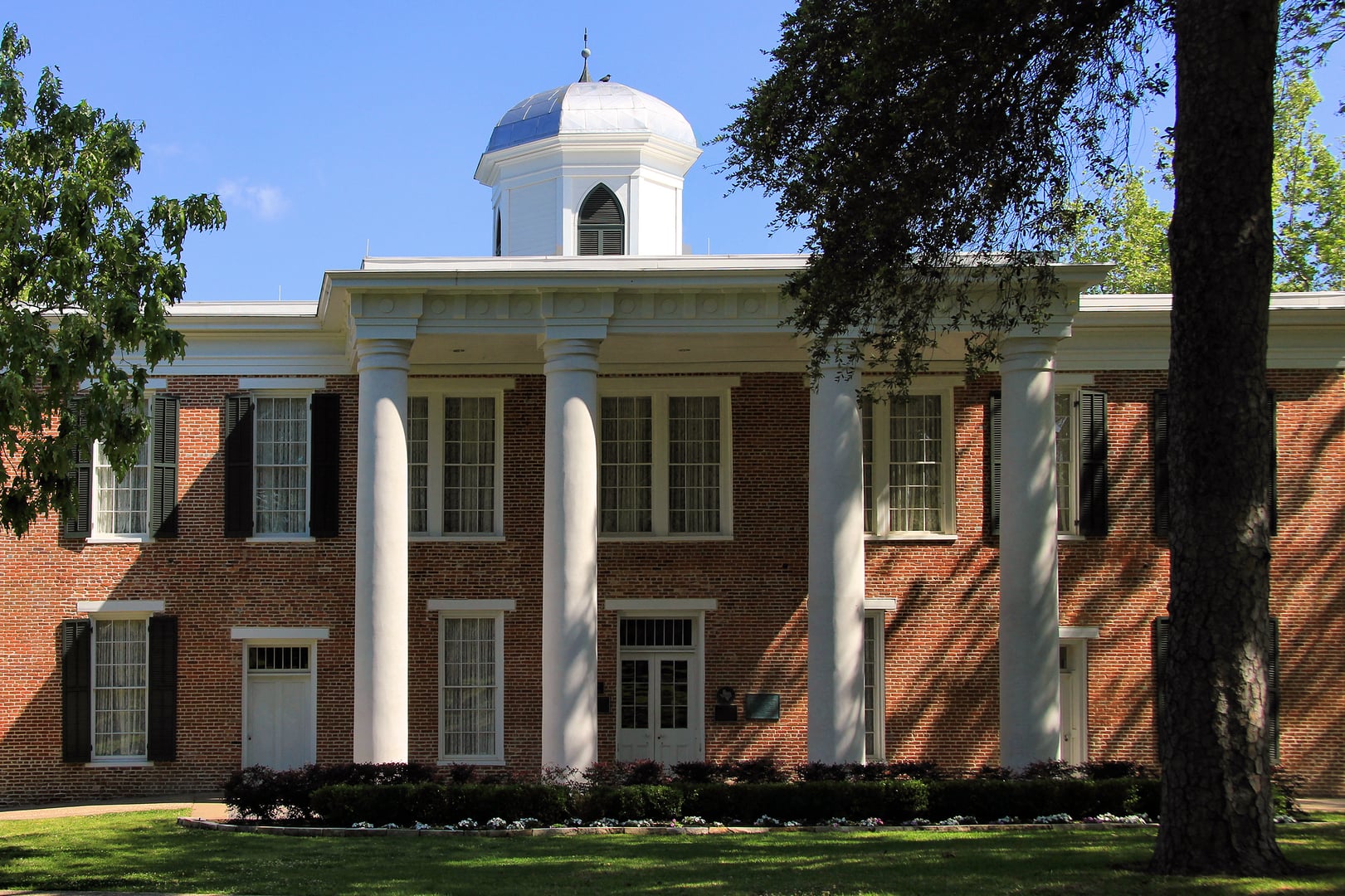
Huntsville, TX
Austin Hall was built in 1851 as the main building of Austin College, one of the earliest colleges established in Texas. When Austin College relocated to Sherman in 1876, the building was absorbed into what became Sam Houston Normal Institute — now Sam Houston State University. Long described as among the oldest surviving academic buildings west of the Mississippi River, it was listed on the National Register of Historic Places in 2013.
Amarillo, TX
Built in 1905 for cattleman and Amarillo mayor Lee Bivins, this brick-and-stone classical home stood at the center of Panhandle society for decades. Mary Elizabeth Gilbert Bivins later bequeathed the property to the city of Amarillo, and it was designated a Recorded Texas Historic Landmark in 1965.
Corpus Christi, TX
Built in 1851 by Walter Merriman, the Merriman-Bobys House is the second oldest structure in Corpus Christi and the oldest within Heritage Park. During the Civil War and the catastrophic 1867 yellow fever epidemic — which killed roughly a third of the city's population — Dr. Eli T. Merriman converted the home into a makeshift hospital. Merriman died of yellow fever himself after treating patients there. The house was moved from 801 South Upper Broadway to Heritage Park in 1982.