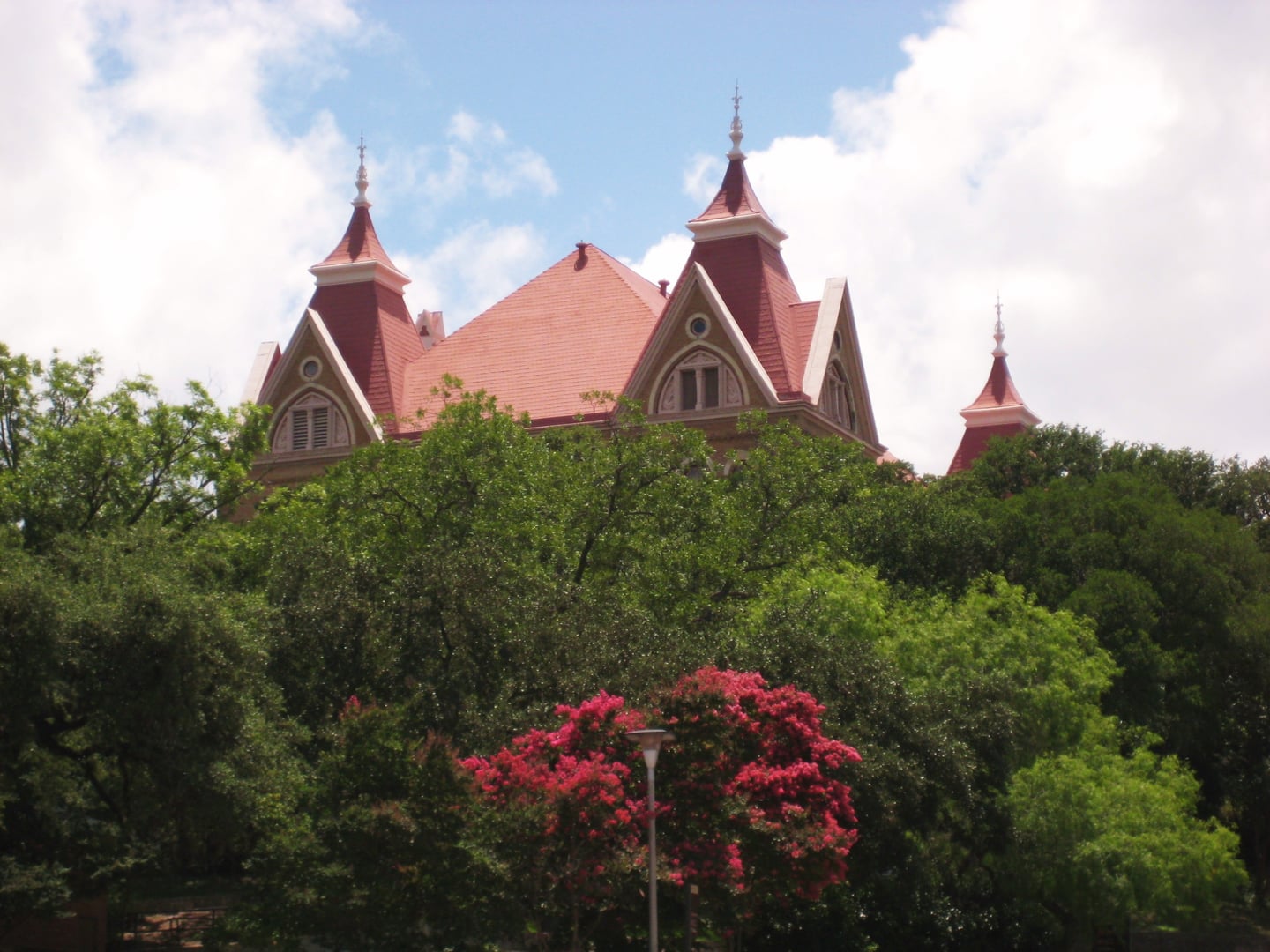
Est. 1840 · First Institution of Higher Education in Texas (1840) · Hugh Roy and Lillie Cullen Building — National Register of Historic Places (1898) · Mood-Bridwell Hall (1908) · Lois Perkins Chapel (1950)
Southwestern University traces its founding to February 5, 1840, when Rutersville College was established — making it the first institution of higher education chartered in Texas. Three additional Methodist colleges followed: McKenzie College (1841), Wesleyan College (1844), and Soule University (1856). The four institutions merged in 1873 under the name Texas University, then renamed Southwestern University in 1875 to distinguish it from the planned University of Texas at Austin.
The university settled in Georgetown, approximately 30 miles north of Austin in Williamson County. The campus grew over the following decades around a central academic mall defined by a semicircular walkway and academic buildings.
The oldest surviving campus structure is the Hugh Roy and Lillie Cullen Building, constructed in 1898 in Richardsonian Romanesque style and listed on the National Register of Historic Places. Mood-Bridwell Hall, built in 1908, housed students for much of the twentieth century and is named for Francis Asbury Mood, the first president of Southwestern University; his monument — originally his tombstone — stands at the building's entrance. The Lois Perkins Chapel opened in 1950 and features Aeolian-Skinner pipe organ and extensive Methodist-themed stained glass. The Alma Thomas Fine Arts Building opened in 1956 with a 700-seat theater and art studios.
The university currently enrolls approximately 1,515 undergraduates as a private liberal arts institution affiliated with the United Methodist Church.
Sources
- https://en.wikipedia.org/wiki/Southwestern_University
- https://www.southwestern.edu/live/news/12971-the-ghosts-of-southwestern
- https://www.southwestern.edu/live/news/15387-the-hauntings-of-southwestern
Doors slamming shut without cause (Mood-Bridwell Hall)Glowing apparition of a woman in a white nightgown (Clark Hall, third floor)Harp and piano music from locked, empty practice rooms (Alma Thomas Fine Arts Center)Footsteps on empty catwalks (Alma Thomas Fine Arts Center)Child crying escalating to screaming (Lois Perkins Chapel)Portrait with eyes that appear to follow observers (Alma Thomas Fine Arts Center)
Southwestern University's ghost lore is unusual among college campuses in that the institution's own communications office has published student-reported accounts on the university website — a level of institutional acknowledgment that makes the Southwestern stories easier to track and cite than most campus folklore.
Mood-Bridwell Hall, the 1908 former dormitory named for the university's founder, is the most frequently cited building. Students and staff describe inexplicable door behavior: a classroom door creaking open slowly and then slamming shut with force, with no person nearby. The building's atmosphere at night is described by multiple accounts as unsettling in ways hard to attribute to specific events.
Clark Hall carries the most visually specific account: a third-floor apparition of a woman with light hair, described in university-published accounts as wearing a white nightgown and appearing to glow. The figure reportedly vanished when the witness moved toward it and it reached a wall.
The Alma Thomas Fine Arts Center is associated with sound phenomena. Students have reported hearing harp music coming from a locked, empty practice room, and separately, piano music with no player present. A photograph of Alma Thomas displayed in the building is described by students as having eyes that appear to follow passersby — a detail that recurs in multiple accounts. Staff have reported footsteps on the building's catwalks without any visible person walking.
Lois Perkins Chapel's account involves sounds attributed to a child, escalating from quiet crying to distressed screaming during late-evening hours, particularly in October.
Notable Entities
F. A. Mood (founder; attributed to Mood-Bridwell Hall)Alma Thomas (namesake; portrait attributed to Fine Arts Center activity)Unidentified woman in white nightgown (Clark Hall)
Where this legend is told