Est. 1855 · Greek Revival house designed and built by Abner Cook (1855-56) · Austin's only intact slave quarters, publicly accessible and interpreted · Civil War Federal hospital · Long-running house museum operated by the Colonial Dames of America in Texas since 1958
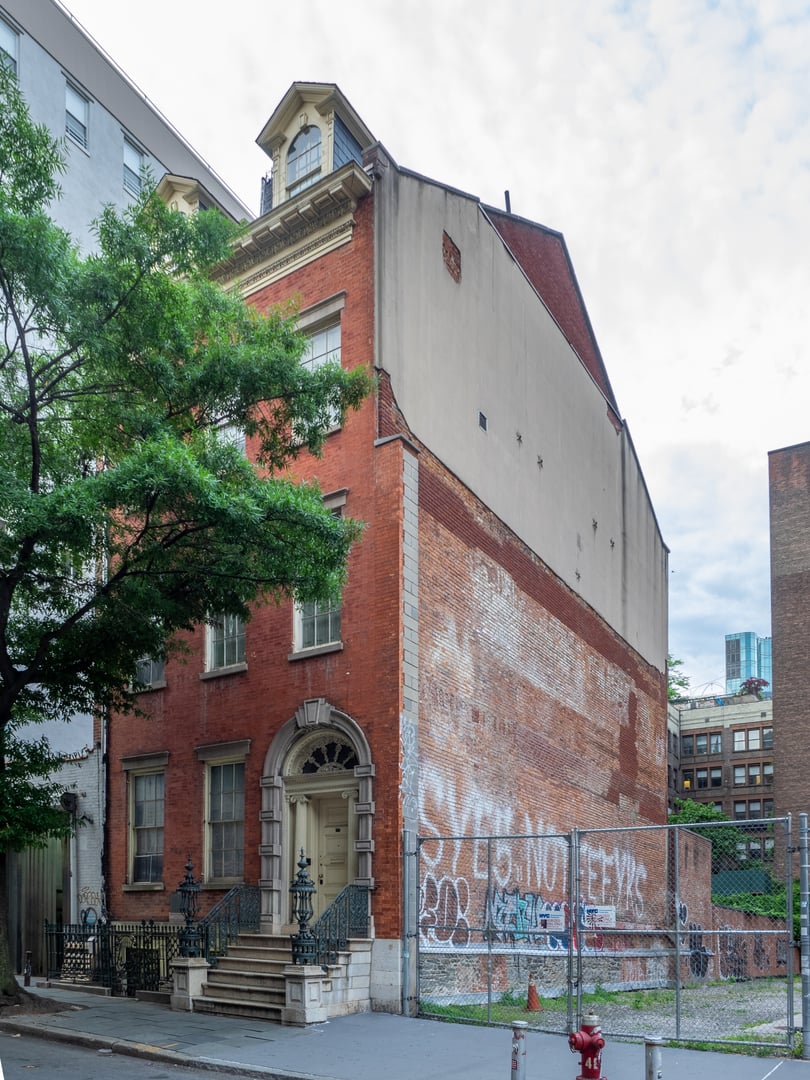
Washington and Mary Hill commissioned the house in 1855-1856 on what was then 17.5 acres on the outskirts of Austin. The architect-builder was Abner Cook, the master builder responsible for the Texas Governor's Mansion and several other defining Greek Revival structures in nineteenth-century Austin. The house features prominent Doric columns, hand-carved 'sheaf of wheat' balusters, and original interior millwork. Construction was carried out in part by enslaved laborers; the surviving outbuilding behind the main house is interpreted today as Austin's only intact slave quarters and is one of very few such structures still standing in any Texas city.
The Hills suffered financial reverses and never occupied the house. In 1856 they leased the building to the State of Texas, which used it as a temporary dormitory and classroom facility for the new Texas Institute for the Blind. At the end of the Civil War the property was occupied as a Federal hospital during the Union occupation of central Texas; this is the most-cited piece of nineteenth-century context that the museum and outside sources connect to its paranormal reputation.
In 1876 the home was sold to Colonel Andrew Neill, a Confederate veteran, and his wife Jennie Chapman Neill. In 1895 Judge Thomas B. Cochran purchased the property, and the Cochran family lived in the home for more than half a century. In 1958 the Cochran family sold the property to The National Society of The Colonial Dames of America in the State of Texas, which opened the Neill-Cochran House Museum to the public in 1962.
The museum's current programming gives substantial space to the lives of the enslaved people who built and maintained the property. The dedicated Slave Quarters Tour, offered on the third Saturday of each month, treats slavery in central Texas - and its continuing influence on the city - as central interpretive material rather than as a footnote.
Sources
- https://www.nchmuseum.org/
- https://en.wikipedia.org/wiki/Neill%E2%80%93Cochran_House
- https://www.nscdatx.org/the-neillcochran-house
- https://www.nchmuseum.org/nchm-events/higs
- https://patch.com/texas/downtownaustin/explore-haunted-history-neill-cochran-house-museum
- https://www.austintexasthings.com/article/inside-the-neillcochran-house-museum-austins-1856-landmark-intact-slave-quarters-the-untold-stories-most-visitors-miss
Apparitions in the upper rooms and balconyFootsteps in unoccupied corridorsSense of presence near the slave quarters and former hospital wingReports of voices in empty rooms during the HIGS programs
The Neill-Cochran House's haunted reputation has been informally established for decades and is now interpreted formally through the museum's "Historic Investigations and Ghost Stories" (HIGS) program, offered in partnership with the Original Austin Ghost Tours. The HIGS program covers paranormal reports across all major periods of the property's history.
The most-cited specific tradition is published on the museum's own site under the title "The Ghost of Robert E. Lee." Per the museum's framing, the legend was preserved orally within the historic Wheatville freedmen's community, an African American settlement immediately adjacent to the property in the late nineteenth century; in the legend, walking past the Neill-Cochran House at night brought a chance of seeing the figure of Robert E. Lee on the upper balcony. The museum presents the legend as a piece of African American oral history tied to the lived experience of Wheatville residents in the post-Reconstruction era rather than as Lost Cause hagiography.
A second body of accounts collected by Austin Patch and on Austin ghost-tour itineraries describes presences associated with the building's Civil War service as a Federal hospital - reports of moaning, the smell of medical antisepsis, footsteps in the corridor, and the sense of a heavy presence in particular rooms.
Reports tied to the surviving slave quarters are treated with explicit editorial care by the museum, which presents the outbuilding through the lens of the human cost of slavery rather than as a 'ghost story.' HauntBound matches that approach: the lore here is inseparable from the people whose labor and lives the property recorded, and is presented as testimony about an emotionally weighted space rather than as entertainment.
Notable Entities
The Wheatville Robert E. Lee figureUnnamed Civil-War-era hospital presences
Media Appearances
- Austin Patch - Explore the Haunted History of Neill-Cochran House Museum
- ATX Things - Inside the Neill-Cochran House Museum