Est. 1913 · French Second Empire Architecture · National Register of Historic Places · Simon Benson Legacy · Curio Collection by Hilton
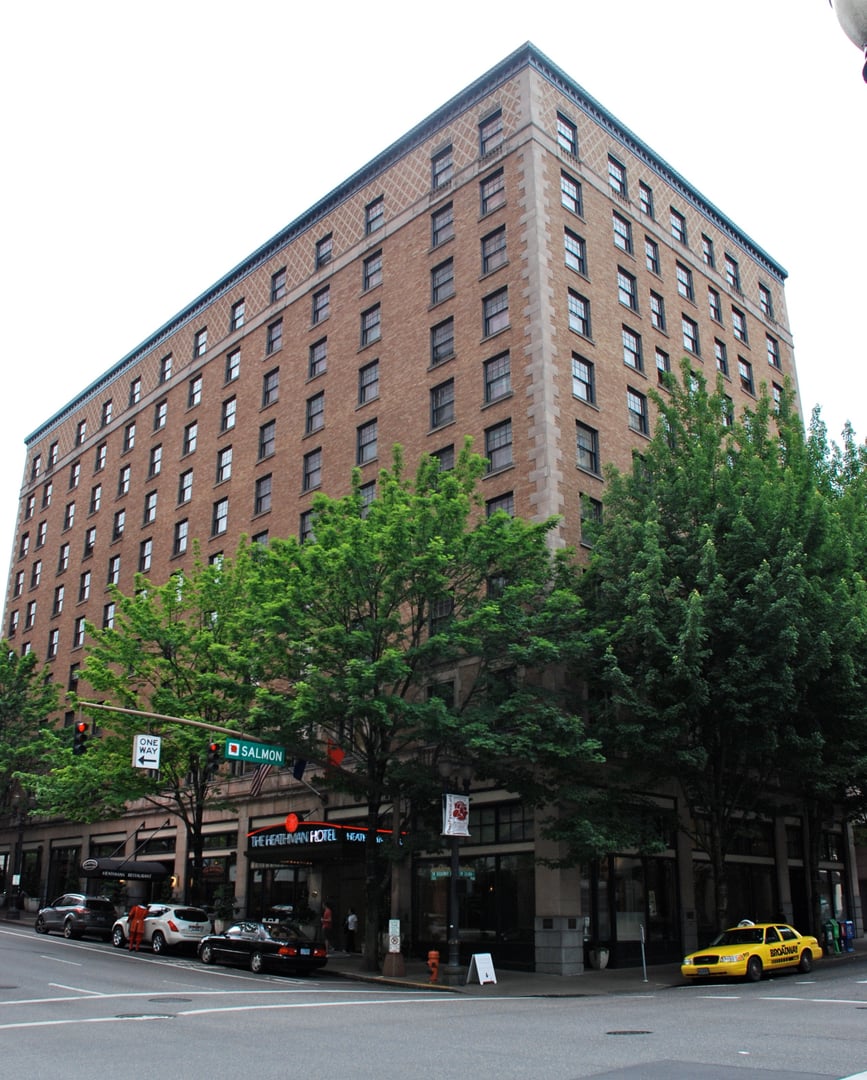
Simon Benson, a Norwegian immigrant who built one of the Pacific Northwest's largest lumber fortunes, partnered with the Wright-Dickinson Company in 1911 to construct a tower wing on SW Broadway. After the partnership dissolved, Benson assumed direct operation in 1914, and the hotel — initially the New Oregon — was renamed in his honor.
The Portland architectural firm of Doyle, Patterson & Beach designed the 12-story building in the French Second Empire style, taking Chicago's Blackstone Hotel as their inspiration. The hotel opened on March 4, 1913, timed to coincide with President Woodrow Wilson's inauguration. With 287 rooms, it is the seventh-largest hotel in Portland by room count today.
Benson himself was widely admired for his civic philanthropy. He famously donated the cast-iron Benson Bubblers drinking fountains to the City of Portland in 1912 and funded contributions to roads, parks, and public works across the region. He was also a strict teetotaler — a detail that becomes germane to the hotel's paranormal lore. Beyond the Portland hotel, Benson built the Columbia Gorge Hotel in Hood River, which opened in 1921.
The Benson was added to the National Register of Historic Places on November 20, 1986. Notable events at the property include the death of Jimi Hendrix Experience drummer Mitch Mitchell, who passed away in his hotel room on November 12, 2008. Coast Hotels & Resorts and partners have owned the property in recent decades; since October 6, 2021, it has operated as 'The Benson Portland, Curio Collection by Hilton.' The hotel retains its original lobby, Italian marble floors, Austrian crystal chandeliers, and Circassian walnut paneling.
Sources
- https://en.wikipedia.org/wiki/Benson_Hotel
- https://www.bensonhotel.com/
- https://portlandghosts.com/the-benson-hotel/
- https://www.hauntworld.com/haunted-hotel-in-portland-oregon-the-benson-hotel-in-portland-oregon
- http://hauntedhoneymoon.com/hauntedplaces/benson.html
- http://americashauntedroadtrip.com/tag/benson-hotel/
ApparitionsDrinks knocked from hands at lobby barReflections without source in lobby mirrorPhantom porter assistance
Per Portland Ghosts, Haunted Rooms America, and Oregon Haunted Houses, the Benson's most-reported apparition is Simon Benson himself, described as a distinguished older gentleman in a formal suit. Sightings concentrate on the 7th, 9th, and 12th floors and the main staircase, and Benson is also frequently described moving through the lobby and bar.
The lore around Benson's lobby-bar activity rests on a documented historical detail: Benson was a strict teetotaler who opposed alcohol consumption. Multiple guest accounts describe drinks being knocked from their hands at the lobby bar, with no other patron near them — phenomena attributed to Benson's enduring disapproval of the bar's modern offerings.
A second frequently-reported apparition is the so-called Lady in White, sometimes described instead as a woman in a turquoise dress with red rings on her fingers. She is reported in the lobby mirror, in the corridors, and occasionally in guest rooms — the variation in description (white versus turquoise) suggests she may be a composite of multiple unrelated sightings.
A child ghost — typically described as a small boy — is reported in the upper-floor corridors and in some guest rooms. A 'friendly night porter' is said to assist guests with luggage or directions and then to vanish before being thanked.
None of these entities are tied to documented deaths in the hotel; the Benson identification depends entirely on the resemblance of the apparition to known photographs of the founder, who died in 1942 at age 90.
Notable Entities
Simon BensonLady in White / Lady in TurquoiseChild ghostPhantom night porter