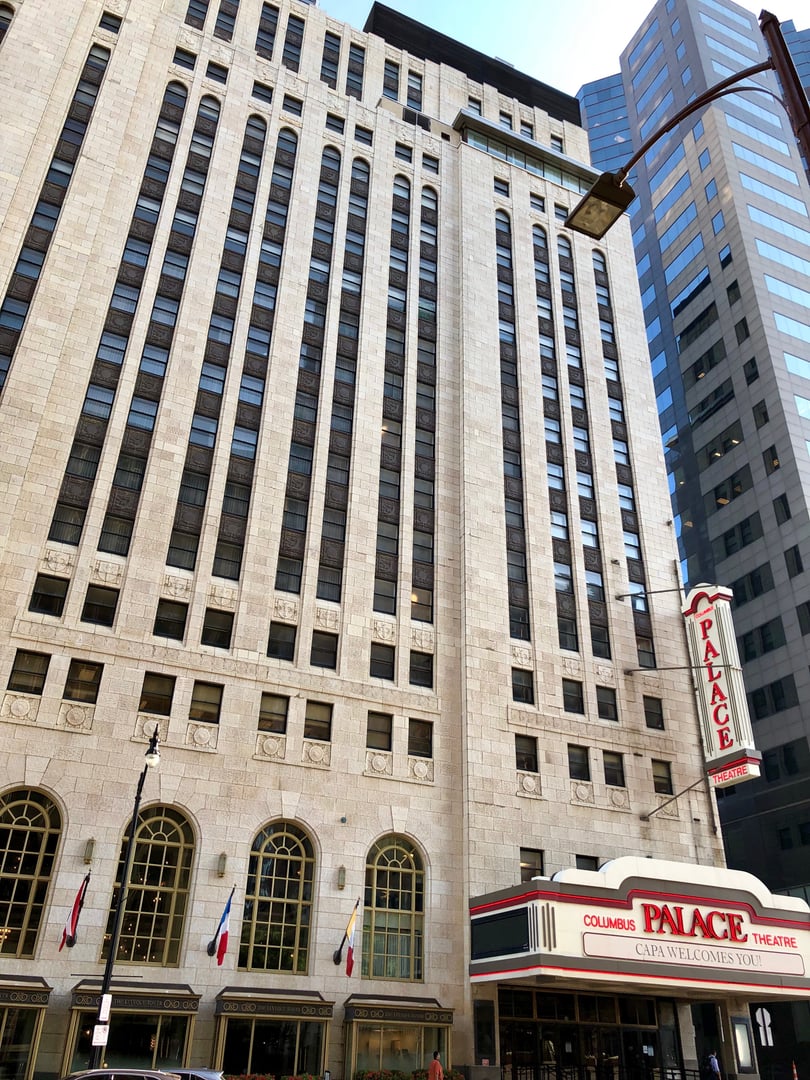
Est. 1928 · National Historic Landmark · Movie Palace Era · Theatre Preservation Movement · Thomas W. Lamb Architecture
Loew's Ohio Theatre opened to the public on March 17, 1928 with the silent film 'The Big City.' Architect Thomas W. Lamb designed the building in the Spanish Baroque idiom, a relatively unusual choice for the Midwest at the time — heavy gilding, twisted Solomonic columns, ornate plasterwork, and a coffered ceiling combining to evoke a 17th-century Iberian palace.
Attendance fell after the Second World War as audiences shifted to suburban theaters and television. The theater closed in 1969, and the property was slated for demolition. Local preservationists organized in response, forming the Columbus Association for the Performing Arts (CAPA) as the nonprofit operator that would raise restoration funds and convert the building from a movie palace to a live performing-arts venue.
The building was added to the National Register of Historic Places on May 5, 1977, and designated a National Historic Landmark the same year. The 1970s restoration returned the interior to its original 1928 appearance and the Ohio Theatre is often cited as one of the earliest and most influential historic-theater restorations in the United States.
In 1984 the adjacent Grand Theatre property was redeveloped into the Galbreath Pavilion, expanding the lobby and backstage facilities without altering the historic auditorium. Today the Ohio Theatre seats roughly 2,791 and is the principal venue of the Columbus Symphony Orchestra as well as a year-round host of touring Broadway, classical, and film events.
Sources
- https://en.wikipedia.org/wiki/Ohio_Theatre_(Columbus,_Ohio)
- http://www.capa.com/venues/ohio-theatre/theatre-history
- https://downtowncolumbus.com/blog/historic-haunts-in-downtown-columbus-to-check-out-this-fall/
- https://takingthekids.com/historic-ohio-theaters-locals-swear-are-seriously-haunted/
ApparitionsObject manipulationPhantom applauseSensed presence
The Ohio Theatre's resident spirit, according to staff and local folklore aggregated by Downtown Columbus, Taking the Kids, and the CAPA-side oral tradition, is 'Charlie,' a stage manager who worked the building in the 1970s. Stagehands tell of Charlie opening elevator doors at odd moments, blowing out lightbulbs during set changes, and otherwise gently interfering with backstage routine — pranks rather than malice.
A second recurring figure is a ghostly usher in vintage uniform who reportedly guides patrons to seats and disappears when thanked. Musicians performing with the Columbus Symphony have reported the sensation of being watched from empty upper balconies and occasional phantom applause from empty seats.
All of these reports are folkloric and second-hand — there is no formal paranormal investigation record at the building, and CAPA does not market the theater as haunted in its primary programming. The stories accumulate through staff anecdotes shared seasonally and through Columbus tourism coverage each October.
Notable Entities
Charlie (1970s stage manager)Vintage-uniformed usher
Media Appearances
- Downtown Columbus — Historic Haunts in Downtown Columbus
- Taking the Kids — 13 Historic Ohio Theaters Locals Swear Are Seriously Haunted