Est. 1929 · Henry Ford Legacy · American Industrial History · Presidential Assassination Artifacts · Edison Legacy · Wright Brothers Heritage
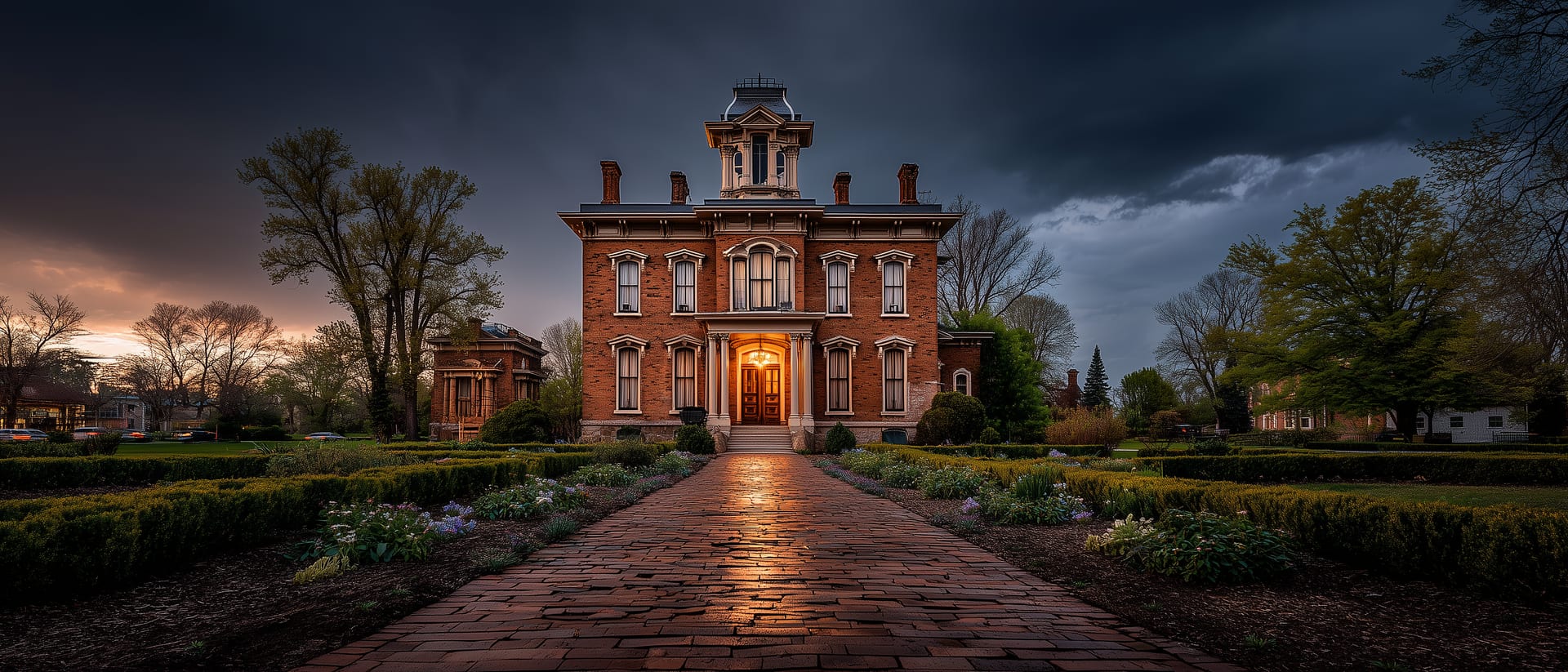
Henry Ford began assembling Greenfield Village in the late 1920s as a direct expression of his conviction that American history resided not in formal documents but in the tools, buildings, and everyday objects through which ordinary people shaped civilization. The village opened to the public in 1929 alongside the Henry Ford Museum of American Innovation.
The collection now spans more than 80 historic structures on 90 acres of grounds in Dearborn. Among the most significant: Thomas Edison's entire Menlo Park laboratory complex, including the building where the incandescent light bulb was perfected; the Wright Brothers' Dayton, Ohio bicycle shop; Noah Webster's New Haven home; and the Logan County Courthouse where Abraham Lincoln practiced law.
The adjacent Henry Ford Museum of American Innovation — housed in a separate indoor building on the campus — contains one of the most sobering artifacts in American political history: the 1961 Lincoln Continental presidential limousine used in Dallas on November 22, 1963. Following Kennedy's assassination, the vehicle was rebuilt with a permanent roof and titanium armor plating. The original midnight blue convertible configuration, in which Kennedy was riding when he was shot, was permanently altered. The limousine remained in presidential service under subsequent administrations before being retired to the museum.
Greenfield Village is operated by The Henry Ford, the nonprofit organization that oversees the entire Dearborn campus.
Sources
- https://www.thehenryford.org/
- https://en.wikipedia.org/wiki/The_Henry_Ford
- http://americashauntedroadtrip.com/spotlight-on-greenfield-village-and-henry-ford-museum/
ApparitionsPhantom soundsPhantom smellsObject movementIntelligent haunting
The paranormal reputation at Greenfield Village is largely an internal institutional knowledge — staff share accounts that the museum's leadership tends not to broadcast. Former employees have described discovering furniture rearranged and drapes drawn back in Sally Firestone's bedroom in the Firestone Farm; the spirit of Sally Firestone herself is said to move through the upper floor and to be visible, occasionally, at the window.
The William Ford Barn has generated a category of account that involves sound rather than sight: unseen horses stamping in stalls, shifting hay, producing the sounds of animals that aren't there. In the Wright Brothers' family home, visitors and staff have reported seeing a woman identified as Katherine Wright, the siblings' younger sister, moving through the rooms.
At the Dagget Farm, the smell of pipe smoke has been detected in autumn months without any physical source — an olfactory report consistent with others at historic properties where a specific person's habits have become part of the building's identity.
The most formally structured account involves the Henry Ford Museum's Kennedy limousine. Each year on or near November 22, staff have reported a figure resembling President Kennedy standing beside the vehicle in the darkened museum. The figure waves to observers — security personnel, in the accounts — and leaves a single red rose on the hood of the car before disappearing. The same figure is reported to communicate, by some accounts, that two men were involved in the assassination, one positioned outside on a grassy area.
Management at The Henry Ford does not officially comment on these accounts.
Notable Entities
Sally FirestoneKatherine WrightJohn F. Kennedy