Est. 1857 · Second-Oldest Maine Light Station · First-Order Fresnel Lens · Washington-Era Federal Lighthouse
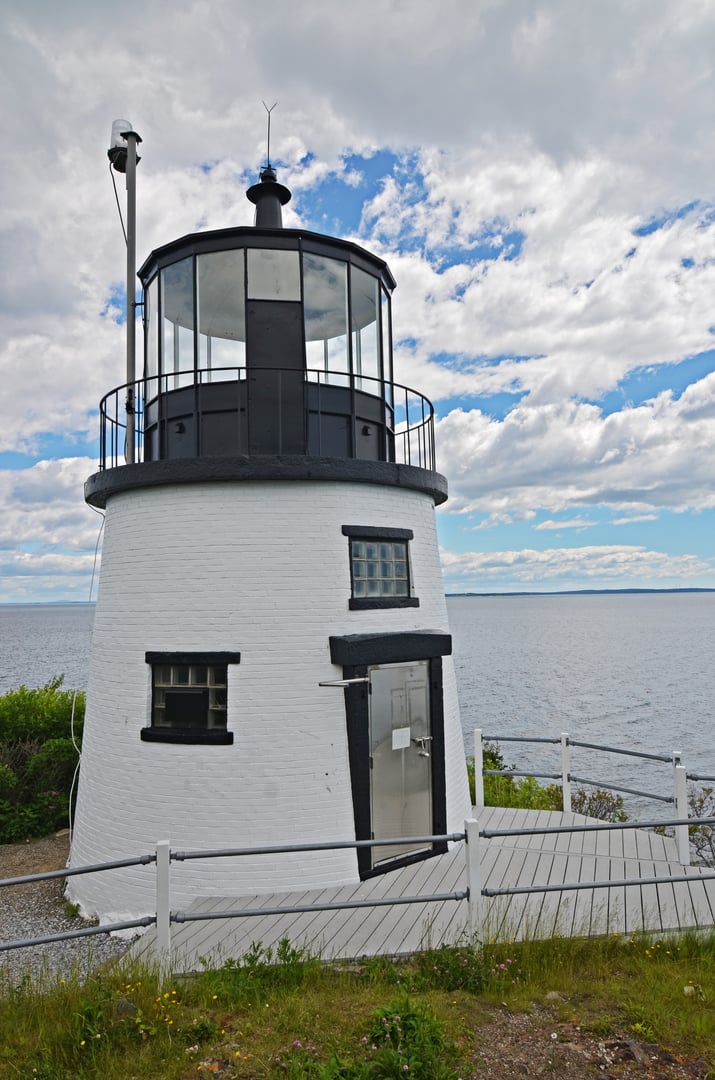
Seguin Island, a rocky 64-acre outcrop two miles off the mouth of the Kennebec River, received its first lighthouse in 1797 by order of President George Washington. The original wooden tower was replaced in 1820 with a stone structure, which itself was rebuilt in 1857 as the granite tower visitors see today. The light stands 180 feet above mean high water, making it the highest coastal light station in Maine.
The 1857 tower retains its original first-order Fresnel lens, the largest size manufactured by Augustin Fresnel's French optical workshops and the only first-order lens still in operating use on the Maine coast. The light was automated by the U.S. Coast Guard in 1985.
The Friends of Seguin Island, a nonprofit founded in 1989, holds a long-term lease on the keeper's quarters and operates a small museum and gift shop on the island during the summer season. The organization stewards the island's hiking trails and maintains the historic tramway that carried supplies up the steep grade from the landing cove.
Access is by private boat or an independent charter ferry operated by RippleSmith Sailing and Captain Shawn Mercer, with two daily trips departing Boothbay Harbor. The crossing can be rough in open ocean conditions, and landings are weather-dependent.
Sources
- https://seguinisland.org/the-haunting-of-seguin-island-light/
- http://www.newenglandlighthouses.net/seguin-light-history.html
- https://www.nelights.com/blog/the-three-ghosts-of-seguin-island-lighthouse-in-maine/
- https://www.pressherald.com/2017/10/24/ghosts-of-seguin-island-light/
Phantom soundsPhantom footstepsPhantom smellsApparitions
The most-circulated Seguin Island story tells of a mid-19th-century keeper who arranged for a piano to be shipped to the island as a remedy for his young wife's isolation. The instrument arrived with only a single piece of sheet music, which the wife played continuously through the long winter. According to the legend, the keeper eventually destroyed the piano with an axe, killed his wife, and then took his own life.
No keeper-of-record entry, court filing, or contemporary newspaper account has been identified to corroborate the story. The Friends of Seguin Island's own website acknowledges the legend's popularity while noting the documentation problems. The Portland Press Herald's 2017 feature on Maine lighthouse ghost stories described the Seguin tale as the state's best-known but also among its most likely apocryphal.
Reported phenomena at the station include faint piano music heard from the keeper's quarters by overnight Friends of Seguin Island stewards, footsteps on the tower stairs when the building is unoccupied, and the smell of pipe tobacco in the parlor. Additional accounts attribute apparitions to a young girl and to a former keeper unrelated to the piano legend; the New England Lighthouse Stories project catalogs these as "the three ghosts of Seguin."
The Tess Gerritsen novelist who summered nearby has discussed the Seguin tale in interviews and on social media, helping to circulate the story in contemporary Maine ghost-lore collections.
Notable Entities
The Piano-Playing WifeThe Young Girl