Drive-By
Exterior viewing on WPI campus
View the Tudor Revival exterior on the WPI campus. Interior access requires a booked alumni or event function.
- Duration:
- 20 min
HauntBound archive · catalog record
Reported phenomena, as catalogued
A 1923 Tudor Revival mansion at Worcester Polytechnic Institute, modeled on c. 1525 Compton Wynyates Castle and the locus of WPI's most-told campus ghost stories.
100 Institute Road, Worcester, MA 01609
Research updated May 2026
Age
All Ages
Cost
Free
Active university administrative building; no general public admission.
Access
Limited Access
Historic mansion with multiple stair levels.
Equipment
Photos OK
Est. 1923 · Tudor Revival mansion designed by architect Grosvenor Atterbury · Modeled on c. 1525 Compton Wynyates Castle, Warwickshire, England · Donated to Worcester Polytechnic Institute in 1971 · Now home of the WPI Office of Alumni Relations
Higgins House was built in the early 1920s as the private residence of Aldus C. Higgins, an industrialist with the Norton Company in Worcester, and his wife Mary (May) Higgins. Architect Grosvenor Atterbury designed the 29-room Tudor Revival mansion as a smaller-scale replica of Compton Wynyates Castle (c. 1525) in Warwickshire, England, and many of the building's materials were imported from the UK and France, including lime-cured lumber in the ceilings.
The house is notable architecturally for its concealed doorways, hidden stairwells, crawl spaces, and a secret parlor window that Mary Higgins reportedly used to peer down at arriving guests so she could choose her outfit accordingly. Hand-painted panels in her dressing room remain a feature of the interior.
Members of the Higgins family lived in the home through Aldus Higgins's death in 1948 and until the property was donated to Worcester Polytechnic Institute in 1971. Since then it has served WPI primarily as the home of the Office of Alumni Relations, and the building functions as a high-use event venue for alumni gatherings, weddings, and university functions.
The campus connection to the Higgins family is layered: Aldus Higgins's brother John Woodman Higgins founded the Higgins Armory across town, and Aldus served as president of the Norton Company. Higgins House remains one of the most architecturally distinctive buildings on the WPI campus.
Sources
Higgins House is the focus of Worcester Polytechnic Institute's most-told campus ghost stories. WPI's own news article 'Haunted Higgins' recounts that the late Nick Mondor '12, then chair of the Student Alumni Society, told of arriving at Higgins House late one night to retrieve something from the SAS office and hearing what he described as a bloodcurdling scream.
The same WPI article describes a 2011 incident in which guests at the annual Haunted Higgins community event praised what they thought was a clever effect: 'the ghost in the second-story window.' According to Rick Baruffi, a former SAS chair quoted in the piece, the staff had not placed any decorations in that window. Baruffi himself notes he has 'never experienced anything out of the ordinary there,' while acknowledging he has 'heard many stories involving alleged ghosts.'
The figure most often named in the lore is Mary (May) Higgins, the home's longtime mistress. The Pulse Magazine's 2015 'Worcester's haunted colleges' summary repeats the campus tradition that Mary is responsible for the activity, framing her presence around the hidden servants' staircase and second-story spaces she frequented in life. Available sources tie the lore to Mary as a character rather than to a specific documented death-on-site incident.
WPI does not market the building as haunted; the Office of Alumni Relations runs the Haunted Higgins event annually as a community gathering. The campus folklore here is unusually well documented by an official university source compared to most college-ghost stories.
Notable Entities
Media Appearances
View the Tudor Revival exterior on the WPI campus. Interior access requires a booked alumni or event function.
Some links on this page may earn HauntBound a small commission when you book, at no extra cost to you. Our editorial picks are independent. Full disclosure
Every HauntBound history is researched from documented sources. We clearly separate verified historical fact from paranormal folklore.
Free Guide
11 verified stops, rated for families, mapped in order. Free.
One email to confirm, then the guide link. Unsubscribe anytime.
Bull Valley, IL
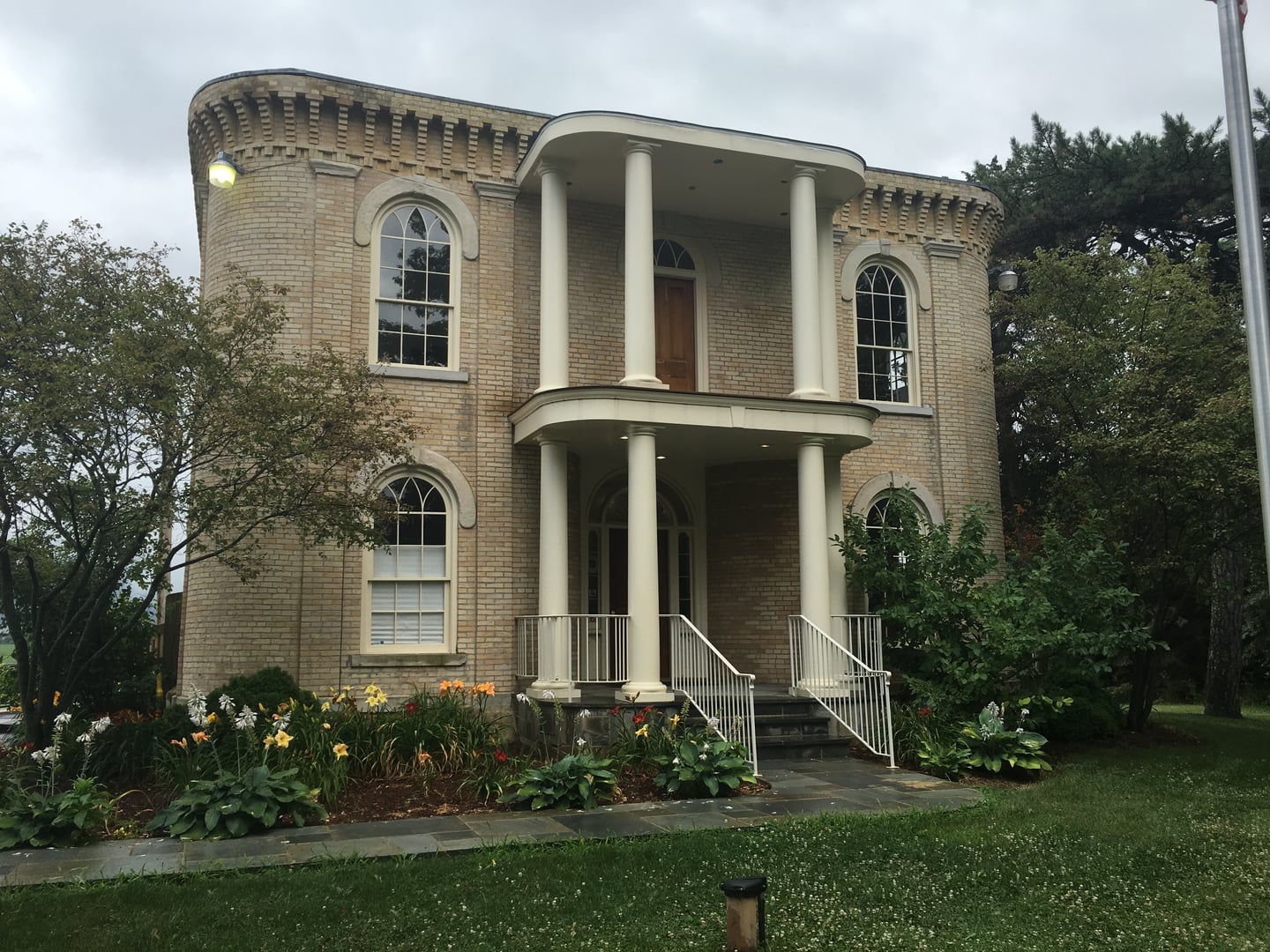
The George Stickney House is an 1865 stucco-over-frame mansion in Bull Valley, Illinois, built for spiritualists George and Sylvia Stickney. The Stickneys, both practicing mediums, are said to have designed the interior without right angles to ease the movement of spirits during seances. The building has served as the Bull Valley Police Department since 1985 and has been listed on the National Register of Historic Places since 1979.
Cambridge, MA
Apthorp House was built in 1760 for the Reverend East Apthorp, the first rector of Christ Church Cambridge, in what was then a rural stretch of Tory Row. Its grand scale earned it the nickname 'the Bishop's Palace.' British General John 'Gentleman Johnny' Burgoyne was held there in 1777–78 after his surrender at Saratoga. The house is now the residence of the Adams House Faculty Deans.
North Adams, MA
Albert C. Houghton, North Adams's first mayor and president of Arnold Print Works, built this Georgian Revival mansion at 172 Church Street in 1897 from plans by architect Henry Neill Wilson. On August 1, 1914, a car carrying Houghton, his daughter Mary, and guests Dr. and Mrs. Robert Hutton crashed in nearby Pownal, Vermont, after swerving to avoid horses on a road under repair. Sybil Hutton was killed instantly; Mary Houghton died later that day. Albert Houghton died of his injuries on August 11, and the family's chauffeur, John Widders, took his own life the following morning. The mansion passed to Houghton's daughters, who sold it to the North Adams Masonic Lodge in 1926; the Lodge sold the property in 2017.