Est. 1814 · Federal Architecture · Civil War History · Nobel Prize Legacy · Blue Grass Trust Preservation
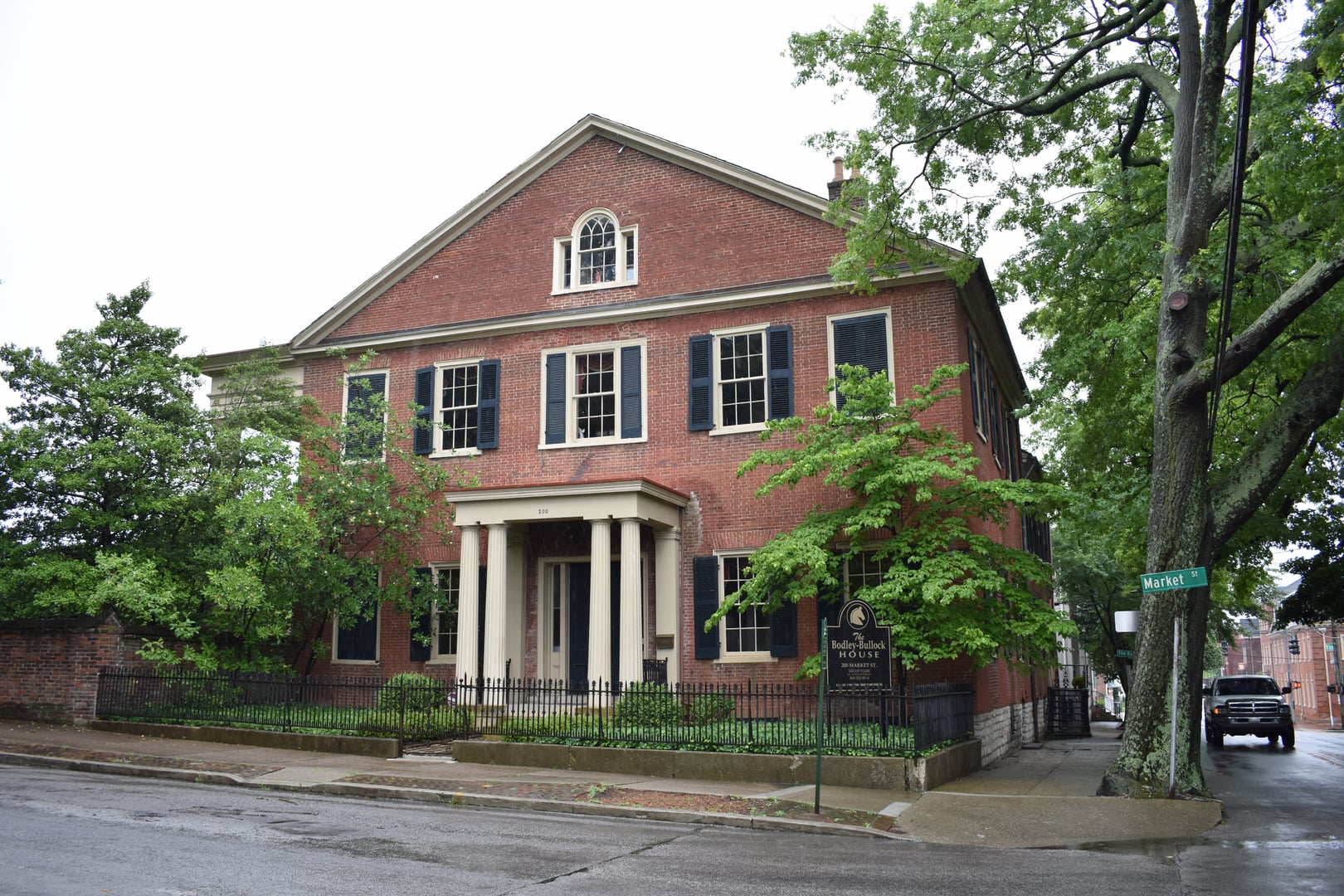
John Wesley Hunt completed Hopemont in 1814, commissioning a Federal-style mansion on the southwestern corner of Gratz Park in Lexington — then earning its reputation as the Athens of the West. Hunt had built his fortune through mercantile trade and was by most accounts the wealthiest man in Kentucky west of the Alleghenies. The house's ornate entryway, with leaded sidelights and an elliptical fanlight, announced his standing without apology. The Palladian window on the second story was a studied architectural gesture toward the cosmopolitan taste Hunt sought to project.
Hunt died suddenly in 1849 of cholera, leaving Hopemont to his descendants. His grandson, John Hunt Morgan, grew up within the house's walls and would later become one of the Confederacy's most celebrated cavalry commanders. Morgan's raids across Kentucky, Indiana, and Ohio earned him the nickname the Thunderbolt of the Confederacy. He was killed in Greeneville, Tennessee in September 1864, ambushed while staying at a private home.
The house's other significant legacy belongs to Thomas Hunt Morgan, great-grandson of the original builder, who was born at Hopemont in 1866. He became the first Kentuckian to receive the Nobel Prize, awarded in 1933 for his work establishing the chromosomal theory of heredity. The same rooms that once hosted a Civil War general also produced foundational discoveries in genetics.
By the 1950s, the house faced demolition amid Lexington's postwar development pressures. The demolition of the adjacent Colonel Thomas Hart House in 1955 galvanized preservationists, and the Foundation for the Preservation of Historic Lexington and Fayette County — later renamed the Blue Grass Trust for Historic Preservation — was established specifically to save Hopemont. The Blue Grass Trust restored the structure to its Federal appearance and opened it as an interpretive museum. The second floor now houses the Alexander T. Hunt Civil War Museum, which holds artifacts, documents, and personal effects from the Morgan family's wartime years.
Sources
- https://en.wikipedia.org/wiki/Hunt%E2%80%93Morgan_House
- https://www.bluegrasstrust.org/hopemont-history
- https://www.battlefields.org/visit/heritage-sites/hunt-morgan-house
ApparitionsSensed presence
The Hunt-Morgan House carries two threads of reported paranormal activity, and they are distinct enough that local accounts keep them separate.
The first centers on John Wesley Hunt himself. Hunt died of cholera in 1849 — suddenly, mid-career, with the kind of unfinished business that attends a man who built a fortune from scratch. Accounts collected by Kentucky paranormal researchers describe a figure consistent with Hunt's era moving through the house's public rooms, particularly on the ground floor. No dramatic interaction has been documented; the reports are of a presence conducting itself with the purposeful air of someone still attending to affairs.
The second apparition belongs to Mammy Bouviette James, a nursemaid who served the Hunt family's children. She is reported to appear on the third floor, in and near the nursery, and is described as attentive rather than threatening. A notable pattern in collected accounts holds that her appearances are most frequently reported by those who are unwell — visitors who later disclosed they had been sick at the time of the visit. No documentation exists for these reports beyond anecdotal collection by local researchers, and they should be understood as oral tradition rather than archived testimony.
The house itself, with its preserved 1814 furnishings and original domestic layout, creates conditions that make reported phenomena difficult to dismiss as suggestion alone. The rooms are genuinely atmospheric — lit by natural light that shifts with the afternoon, arranged around objects that belonged to people who died in them or who shaped the nation from within them. Whether the Hunt-Morgan House hosts something unexplained or simply holds the weight of concentrated history, it rewards visitors who arrive with curiosity.
Notable Entities
John Wesley HuntMammy Bouviette James