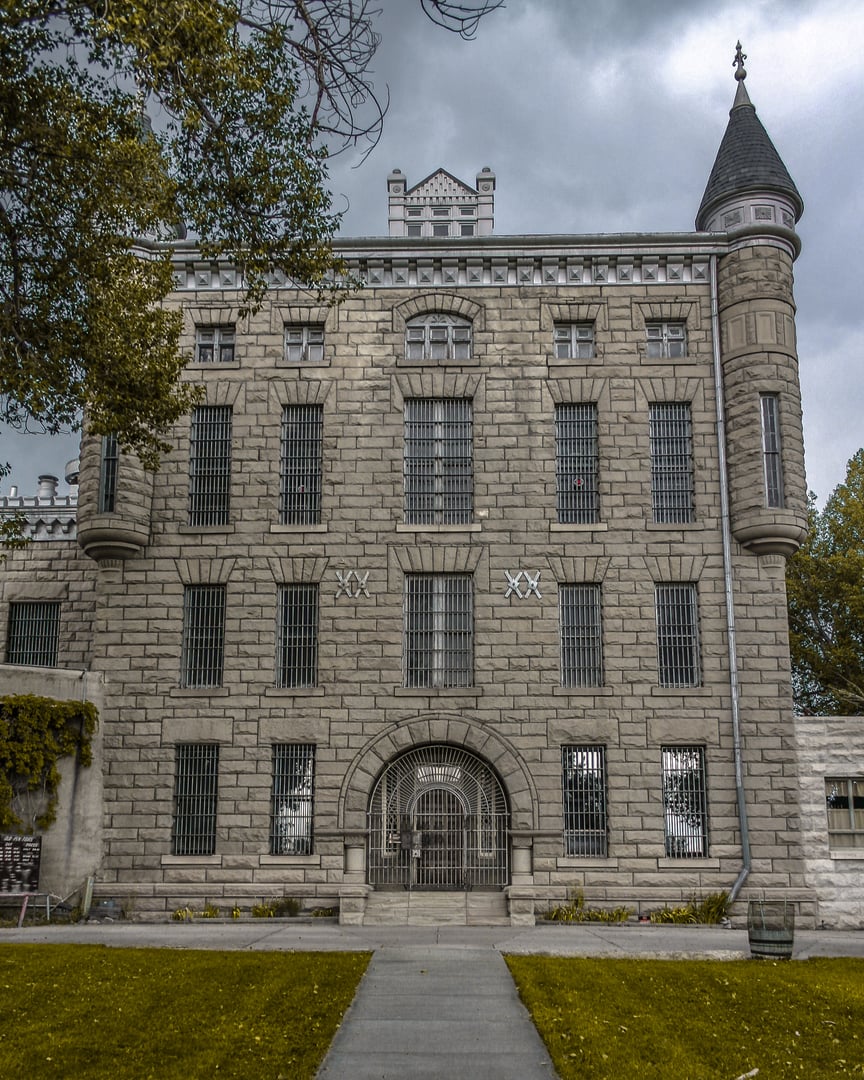
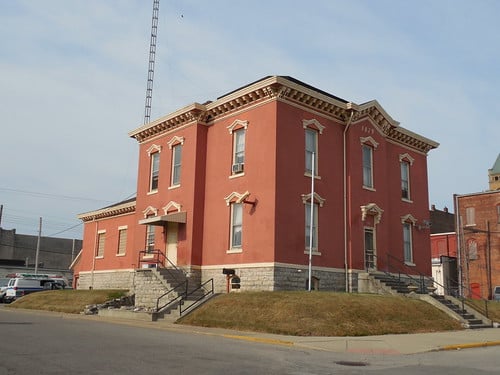
Est. 1882 · First rotary jail constructed in the United States (1882 patent) · Only surviving rotary jail still capable of rotation · John Coffee botched execution — three attempts, October 16, 1885 · New York Times coverage, October 17, 1885
The Montgomery County Jail was constructed in 1882 to a design patented the previous year by Indianapolis architects William H. Brown and Benjamin F. Haugh. The patent covered what the inventors called an 'epicycloidal cell system' — a cylindrical carousel of wedge-shaped cells mounted on a central rotating column. A single jailer could align any cell with the single access opening by turning a hand crank, preventing inmates from moving freely through the tier without being directly exposed to staff.
Crawfordsville's jail was the first built to this design, making it the prototype for approximately seventeen rotary jails ultimately constructed across the United States. The Pottawattamie County Squirrel Cage Jail in Council Bluffs, Iowa, built in 1885, was the only three-story example; the Montgomery County version is two stories. It is the only surviving rotary jail still capable of rotation.
The facility's most documented historical event occurred on October 16, 1885. John Coffee, convicted of murder, was scheduled to be hanged at the jail. The scaffold malfunctioned on the first drop; Coffee was left hanging without dying. A second attempt also failed. A third attempt succeeded, and Coffee died approximately fifteen minutes after the initial drop. The New York Times covered the event on October 17, 1885; the Newport Hoosier State reported it on October 28, 1885. The Indiana Historical Bureau has confirmed the event in its historical record.
The jail operated until the mid-twentieth century. The building was preserved and opened as a museum, with the Montgomery County Cultural Foundation operating what became the Rotary Jail Museum. The rotary mechanism has been maintained in working order and demonstrated for visitors as part of the standard tour.
Sources
- https://notebookofghosts.com/2019/10/23/the-spectacle-was-sickening-the-rotary-jail-and-the-thrice-hanged-ghost/
- https://www.rotaryjailmuseum.org/haunted-jail
- https://en.wikipedia.org/wiki/Rotary_jail
- https://www.journalreview.com/stories/paranormal-investigators-to-visit-rotary-jail-museum,281227
Security system triggers in October with no causeCold spots in cell tierPhantom footstepsDisembodied soundsUnease near execution site
The botched 1885 execution of John Coffee produced one of the more documented ghost stories in Indiana history. Coffee was hanged three times before he died, the scaffold failing twice — an event widely covered in the regional and national press at the time. His name has been associated with paranormal activity at the jail in every decade since the building became a museum.
The most frequently cited evidence comes from the museum's own security systems. Staff have described the building's motion sensors triggering in October — the anniversary month of the execution — when the building is otherwise empty and no environmental cause has been identified. The pattern has been noted by the museum in its public programming and is incorporated into the Haunted Jail seasonal events.
Visitor accounts cluster around the rotary mechanism and the area of the building associated with the execution. Investigators and museum guests describe a sensation of unease near the scaffold site, cold spots in the second-floor cell tier, and sounds — both footsteps and low vocalizations — from the cell area when no one is present on that level.
The Notebook of Ghosts blog published a detailed examination of the Coffee execution in 2019, drawing on primary newspaper sources including the New York Times (Oct. 17, 1885) and the Newport Hoosier State (Oct. 28, 1885) and situating the paranormal claims in the documented historical record. That piece is the most thorough public source connecting the execution's documented details to the subsequent haunting accounts.
Notable Entities
John Coffee
Where this legend is told