Est. 1897 · First American Journalist Killed for Press Freedom · Abolitionist Movement · Illinois State Historic Site · National Register of Historic Places
Elijah Parish Lovejoy arrived in Alton in 1837 after being driven from St. Louis, where his anti-slavery editorials in the Observer had made him an object of increasing hostility. He continued publishing in Alton, though three of his printing presses were destroyed and thrown into the Mississippi River by hostile crowds before the night of November 7, 1837, when a proslavery mob besieged the warehouse where Lovejoy and supporters were sheltering his fourth press. He was shot and killed during the confrontation at age 34.
Lovejoy's death drew national attention and became a catalyst for the abolitionist movement, transforming him into a martyr figure whose killing demonstrated the stakes of free-press advocacy in the antebellum period. He is generally recognized as the first American journalist killed in the defense of press freedom.
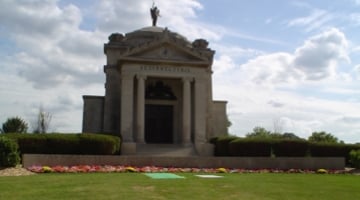
The Illinois state memorial in Alton City Cemetery was dedicated in 1897, sixty years after his death. Sculptors Robert Porter Bringhurst and Richard W. Bock designed the three-component monument: a 93-foot central limestone shaft topped by a 17-foot bronze figure of Victory, with two flanking shafts surmounted by bronze eagles. The overall composition stands more than 300 feet above the Mississippi River on the Alton bluff. An architectural curiosity of the base — a semicircular bench — creates an acoustic effect that transmits whispered speech from one end to the other even when the speaker and listener are out of line of sight. The memorial is maintained as a state historic site by the Illinois Department of Natural Resources and is open dawn to dusk at no charge.
Sources
- https://en.wikipedia.org/wiki/Elijah_P._Lovejoy_Monument
- https://dnrhistoric.illinois.gov/experience/sites/southwest/elijah-lovejoy.html
- https://www.enjoyillinois.com/explore/listing/elijah-p-lovejoy-monument/
Cold spotsApparitions
The ghost tradition at the Lovejoy Monument Cemetery operates on two tracks. The first and more extensively documented involves Elijah Lovejoy himself: regional ghost accounts, compiled by multiple paranormal sources covering Alton's well-developed dark tourism circuit, describe a male figure in period dress walking near the monument and Lovejoy's grave. The figure is characterized as unhurried and purposeful, matching the posture associated with Lovejoy in the portraits and engravings in circulation during his life.
The second tradition involves a young girl whose grave is located within the cemetery. She is described as having died suddenly of an unidentified illness. Accounts report her visible near and between the older gravestones, described in terms more consistent with a child at play than with distress — darting behind headstones in a pattern witnesses have compared to hide-and-seek.
The cold spots reported throughout the cemetery are the most accessible and most commonly noted phenomenon — visitors record temperature anomalies at the grave and near the monument independent of the apparition accounts, and several note the effect occurring in summer temperatures well above 80 degrees.
Alton has a strongly developed ghost tourism culture, and the Lovejoy Cemetery sits within a broader network of documented sites. The combination of genuine historical tragedy and a visually dramatic setting has sustained the location's place in that culture for decades.
Notable Entities
Elijah P. LovejoyThe Young Girl