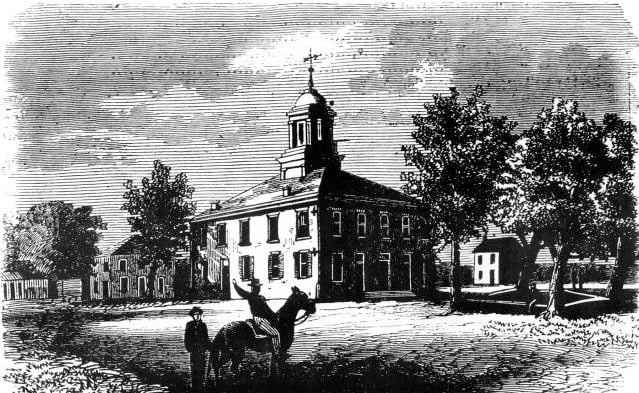
Est. 1833 · Illinois's First State Penitentiary · Union Civil War POW Facility 1862-1865 · 1863 Smallpox Outbreak — 1,354 Deaths · National Register of Historic Places 1974
The Alton penitentiary opened in 1833 as Illinois's first state prison, constructed of local limestone on the bluffs above the Mississippi River. After the state built a newer facility at Joliet, the Alton structure was condemned as unsuitable and closed in 1860.
When the Civil War began, the Union Army needed prisoner-of-war holding capacity in the western theater. In February 1862, the shuttered prison was pressed back into service as a military detention facility. Over its three-year run it held approximately 11,000 Confederate soldiers — many of them from Missouri, Kentucky, and Tennessee — under severely overcrowded and unsanitary conditions.
The deadliest episode came in the winter of 1862–1863 when a smallpox epidemic swept through the compound. Isolation facilities were inadequate and the disease moved through the population with devastating speed. According to Union Army records, 1,354 Confederate prisoners died at Alton, the majority from the smallpox outbreak. The dead were transported by barge and buried on Sunflower Island in the Mississippi River, where a Confederate memorial stands today.
The prison closed in July 1865, shortly after the war's end. The structures gradually deteriorated; by the mid-20th century only one section of the original limestone wall remained standing on William Street at Broadway in downtown Alton. That remnant was added to the National Register of Historic Places in 1974. A bronze memorial tablet and interpretive signage were installed at the site, making it part of Alton's broader Civil War heritage trail.
Sources
- https://en.wikipedia.org/wiki/Alton_Military_Prison
- https://www.riversandroutes.com/directory/alton-prison/
- https://www.goworldtravel.com/travel-ghosts-off-mississippi-haunts-of-alton-illinois/
Phantom VoicesUnexplained Cold SpotsShadowy FiguresEVP Recordings
Alton has built a regional reputation as one of the most actively haunted small cities in the United States, and the military prison wall anchors that reputation. Newspaper accounts from as early as 1885 — documented by local historian and author Troy Taylor — describe residents hearing indistinct voices and sounds near the site at night, years after the prison had been demolished to its current remnant state.
Taylor's American Hauntings tours, which have operated in Alton for years, include the wall as a primary stop on both walking and trolley routes. Tour guides recount reports of unexplained cold spots along the limestone face, phantom voices speaking in Southern accents, and on occasion dark silhouettes seen moving near the base of the wall after dark. Investigators have recorded EVP sessions at the site, though none of the findings have been independently verified.
The scale of death at the facility — over 1,300 men in a confined space over three years — gives the site a weight that even skeptical visitors tend to acknowledge. The buried dead were removed to an island in the Mississippi, and local legend holds that not all of them found their way there.
Where this legend is told