Est. 1900 · National Register of Historic Places · University of Illinois Property · Robert Allerton Estate · Georgian Revival Architecture
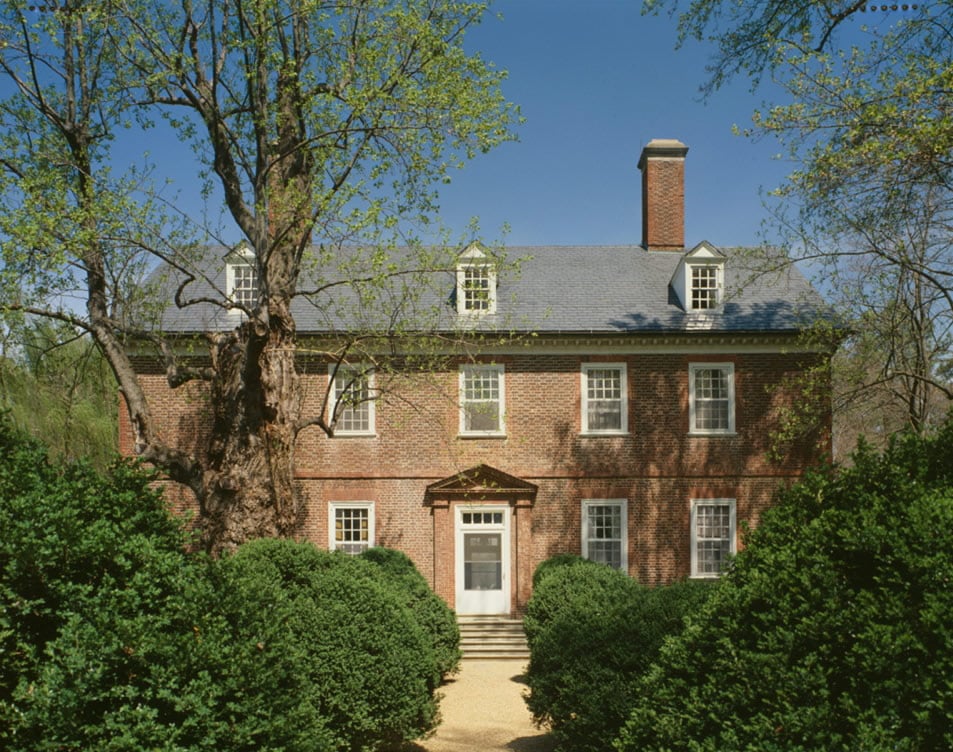
Construction on Robert Allerton's country house began on June 13, 1899, and the residence was substantially complete a year later. The architect was John Borie, a Philadelphia-trained designer whose plans drew on 17th-century English country houses, particularly Ham House outside London. The result is a 30,000-square-foot Georgian Revival residence of 40 rooms, surrounded by stables, greenhouses, and a gate house added between 1901 and 1903. The original construction cost was roughly $50,000, equivalent to about $1.3 million in 2011 dollars.
Robert Allerton was born in 1873, the only surviving son of Samuel Waters Allerton, one of the founders of the Chicago Union Stock Yards and the First National Bank of Chicago. After studying painting in Munich, Paris, and London, Robert returned to Illinois in 1897 and turned his attention to landscape design, sculpture collection, and the development of the family farmland his father called The Farms. Over the next 47 years he transformed the estate into a series of formal gardens, allées, and outdoor sculpture installations modeled on European and Asian precedents.
In 1922, Allerton met John Gregg, a young architecture student at the University of Illinois. Gregg eventually moved into the mansion, took the surname Allerton, and was legally adopted by Robert in 1960. The two collaborated on the gardens for decades. On October 14, 1946, the partners deeded the 5,500-acre estate, then valued at approximately $1.3 million, to the University of Illinois. Robert and John relocated to Kauai, where they developed a second garden estate that survives as the National Tropical Botanical Garden.
The University retained the mansion as a 4-H camp, conference site, and retreat center. Today the 1,500-acre property operates as Allerton Park & Retreat Center under the University of Illinois Urbana-Champaign. The mansion serves as overnight lodging and a wedding and events venue, while the gardens, sculpture trails, and woodland paths remain open to the public free of charge. The site is listed on the National Register of Historic Places.
Sources
- https://en.wikipedia.org/wiki/Robert_Allerton_Park
- https://allerton.illinois.edu/
ApparitionsPhantom footstepsEVPResidual haunting
The most persistent paranormal report at Allerton Mansion concerns a woman in white. Witnesses describe seeing her in one of the upstairs guest rooms, where she is said to appear at a dressing table putting on hats and gloves, and pacing the hallway in front of the same room. The figure has also been reported walking the path beside the reflecting pond at the rear of the mansion, and footsteps without a visible source have been heard descending the staircase.
Local tradition links the apparition to a guest who frequently stayed at The Farms during Robert Allerton's tenure. Two candidates surface most often in retellings: Agnes Allerton, a relative who spent extended periods at the estate, and the American portrait painter Ellen Emmet Rand, who was associated with Allerton in the early 20th century. No documentation conclusively identifies the figure, and the lore appears to derive primarily from staff and visitor reports collected after the property became a public retreat center.
In April 2019, the Ghost Research Society and Afterlife Tours, Inc. conducted an overnight investigation in the mansion. Investigators set up sessions in the Ballroom, the Library, and an upstairs guest room they identified as Room 6, using EVP recorders, an Ovilus device, and a Phasma Box. The team reported responses on the spirit-communication devices and what they characterized as disembodied voices, though no audio or video evidence has been independently verified.
Guests staying overnight in the mansion occasionally describe a sense of presence in the upstairs corridors after the building has settled for the night. Daytime visitors most often note an atmospheric heaviness in the gardens at the back of the house, near the reflecting pond where the Lady in White is most frequently described.
Notable Entities
Lady in White