Est. 1896 · San Francisco Landmark #75 · National Register of Historic Places · 1906 earthquake survivor · Nazi consulate site (1941) · Edward R. Swain architecture
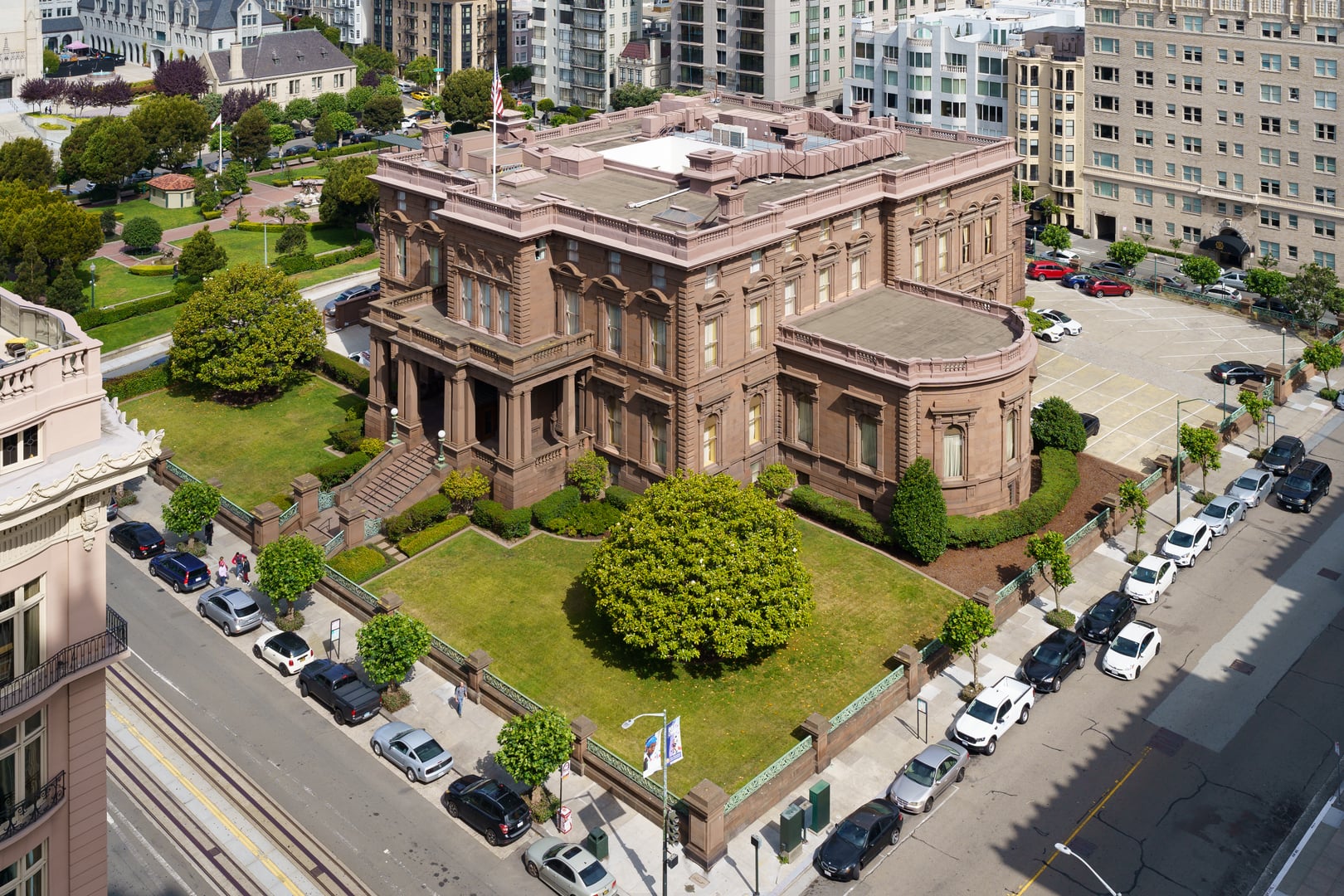
Edward Robinson Swain designed the Whittier Mansion between 1894 and 1896 for William Franklin Whittier (1832-1917), a Maine-born industrialist who arrived in San Francisco in 1854 and built a fortune in paints, oils, and white lead through the firm Whittier, Fuller & Co. Construction cost approximately $152,000 — the equivalent of more than five million dollars today — and produced a 30-room residence faced in Arizona red sandstone over steel-reinforced brick, with one of the first residential elevators in the city.
The mansion sits on the southeast corner of Jackson and Laguna in Pacific Heights and was engineered to resist seismic activity; when the 1906 earthquake leveled blocks of nearby brick construction, the Whittier survived essentially intact and became one of the relatively few Pacific Heights mansions of its scale to remain standing.
In 1941 the German government purchased the mansion for use as its West Coast consulate and Nazi Party headquarters. Fritz Wiedemann, a former personal adjutant to Adolf Hitler, ran propaganda and intelligence operations from the building until the United States expelled German diplomatic staff that July; the property was formally seized by the U.S. Office of Alien Property Custodian in 1947 and sold at auction in 1950.
The California Historical Society occupied the mansion from 1956 until 1991, after which the building returned to private ownership and continues to be used as a residence and event venue. San Francisco designated it Landmark No. 75 on November 8, 1975, and it was added to the National Register of Historic Places on April 26, 1976.
Sources
- https://en.wikipedia.org/wiki/Whittier_Mansion
- https://noehill.com/sf/landmarks/sf075.asp
- https://www.loc.gov/item/ca0748/
ApparitionsCold spotsSense of being watchedShadow figures
Stories about the Whittier Mansion are largely retrospective — collected after the California Historical Society had been in residence for decades and the building had passed back into private hands. According to SF Ghosts and other local ghost-tour resources, former docents reported a recurring sense of being watched in the wine cellar, sudden cold pockets in the maid's quarters at the top of the house, and the appearance of a short bald male figure on the second floor that some accounts associate with a longtime butler.
A female apparition seated quietly in a parlor chair has been reported by a smaller number of witnesses; she is not consistently identified, though some accounts tie her to Whittier family members who lived in the house in its first decades. The dominant resident-spirit identification in local lore is William F. Whittier himself, or — in a smaller subset of reports — his son William 'Billy' Whittier.
A more recent layer of speculation attaches to the building's brief tenure as the West Coast Nazi consulate in 1941, with some ghost-tour narratives suggesting that figures glimpsed in the upper rooms could be tied to that period. None of the consulate-era claims appear in pre-2000 sources and they should be treated as later folkloric additions rather than continuous oral tradition.
The mansion is a private residence and event space, so independent verification of paranormal claims is limited; nearly all of the lore is filtered through the California Historical Society period (1956-1991) or repeated by haunted-history writers without direct access to the current owners.
This venue is a private residence and event space and not open to the public — appreciate from the public sidewalk at Jackson and Laguna only.
Notable Entities
William Franklin Whittier (purported)Unidentified bald male figure / butlerSeated female apparition