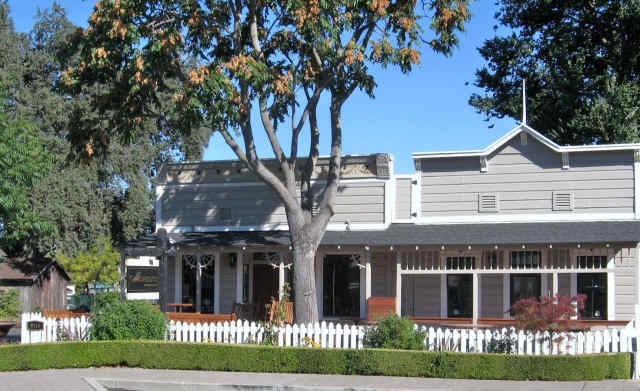
Est. 1873 · One of Clayton's oldest continuously operating businesses · Building element shipped from San Francisco via Martinez · Survived Prohibition as a community cafe and social club
The Clayton Club Saloon at 6096 Main Street is one of the most historically continuous bar businesses in the town of Clayton, in eastern Contra Costa County at the foot of Mount Diablo. According to the Clayton Historical Society, the building was constructed by Jacob "Jake" Rhine around 1873 at the corner of Main and Morris streets. Rhine operated a hotel, saloon, and ice-cream parlor on the site from 1874 to 1898. By 1898 the saloon was known as the National Saloon.
In 1905, Carl Berendsen purchased the property and renamed it the Clayton Club. Berendsen added a structure that was shipped from San Francisco to Martinez and then transported overland to Clayton, where it was joined to the existing building. The combined structure was used as saloon, restaurant, and family residence during the early twentieth century. During Prohibition (1920 to 1933) the operation continued as the Clayton Cafe, a social club, and survived the dry era by selling food and operating as a community gathering place.
Local records and the Shadowlands archive both refer to a building component as having originated from an earlier San Francisco saloon known as the Eagle Saloon, dating to the 1860s. The Clayton Historical Society's documented chronology dates the Rhine building to 1873; the San Francisco origin appears to refer to the structure added by Berendsen in 1905. Visitors should consult the Clayton Historical Society and the saloon's published history for the full chronology.
Sources
- https://claytonhistory.org/history/clayton-club-saloon/
- https://www.hmdb.org/m.asp?m=57976
- https://pioneerpublishers.com/claytons-original-village-grocery-has-its-roots-in-the-eagle-saloon/
Objects moving on their ownGlasses sliding on tablesCold spotsLights turning on and off
Local tradition associates the Clayton Club Saloon with a long history of unexplained activity reported by staff and patrons. Accounts collected by the Clayton Historical Society and by California ghost-tour operators describe objects moving on their own, glasses sliding across the bar, sudden cold spots in specific corners of the room, and lights switching on and off without an obvious cause. These reports are typical of the kind of folk lore that has accumulated around long-running town saloons in California, where staff continuity over many decades preserves accounts that newer venues lack.
None of the reports are corroborated in newspaper coverage. The saloon is a working bar; visitors should treat it as an evening dining-and-drinking destination rather than a paranormal investigation site.