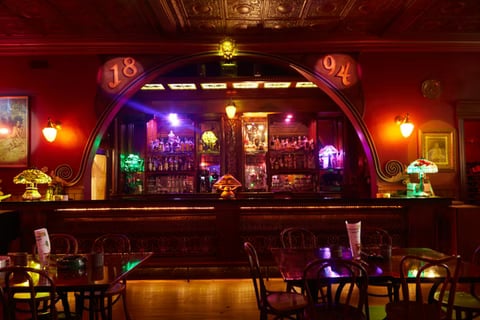
Est. 1898 · Klondike Gold Rush · Skagway Historic District · National Historic Landmark · Surviving 1898 gold-rush bordello
The Red Onion Saloon was established in 1898 in Skagway, the tidewater port where tens of thousands of stampeders landed before crossing the White Pass toward the Klondike gold fields. Like much of early Skagway, it was a multipurpose operation: a dance hall and saloon on the ground floor, and a bordello on the floor above. Ten small rooms, known as cribs, opened off the upstairs hallway. A row of ten dolls stood behind the downstairs bar, one for each woman working above; a doll laid on its back signaled that a woman was occupied, and was set upright again when she came back down.
Skagway grew from a near-empty shoreline to a town of more than ten thousand in under two years, then contracted just as fast once the rush moved on. The Red Onion outlasted that boom-and-bust cycle and the building was moved from an earlier location, as documented by the National Park Service. Over the twentieth century the structure passed through several uses before being restored and reopened as a saloon and restaurant.
Today the upstairs rooms are preserved as the Brothel Museum, where guides present the documented history of the women who worked there as labor and social history of the frontier rather than as spectacle. The building sits within the Skagway Historic District, a National Historic Landmark managed in cooperation with Klondike Gold Rush National Historical Park, and it is one of the most-visited stops on Broadway during the summer cruise season.
Sources
- https://redonion1898.com/
- https://www.atlasobscura.com/places/red-onion-saloon
- https://moonmausoleum.com/the-soiled-dove-haunting-the-red-onion-saloon-in-skagway/
- https://www.jahernandez.com/posts/lydias-ghost-at-red-onion-saloon
- https://www.easybakecovenpodcast.com/episodes/ep-6-the-ghosts-of-the-red-onion-saloon
Phantom footstepsPhantom perfumeSense of being watchedApparitions
The Red Onion's best-known story is Lydia, a presence the staff associate with one of the women who worked in the upstairs cribs during the gold rush. The reports are consistent across the venue's own accounts and outside write-ups: footsteps crossing the second floor when no one is up there, the smell of perfume in the museum rooms, plants that staff say water themselves, and a general sense of being watched while leading tours through the former bordello.
The haunting reputation is part of why the upstairs became a museum rather than simply preserved rooms. Guides recount the documented history of the women alongside the reported phenomena, drawing on the building's atmosphere: a narrow upstairs hallway, the original cribs, and the long sightlines down to the saloon floor.
Some accounts describe more than one presence at the Red Onion, including a male spirit said to be less welcoming than Lydia. As with most working-saloon hauntings, the stories are anecdotal and tied to staff and visitor experience rather than to any formal investigation. What is documented is the building itself, the use of the upstairs rooms, and the long-running tradition of telling Lydia's story to the people who pass through.