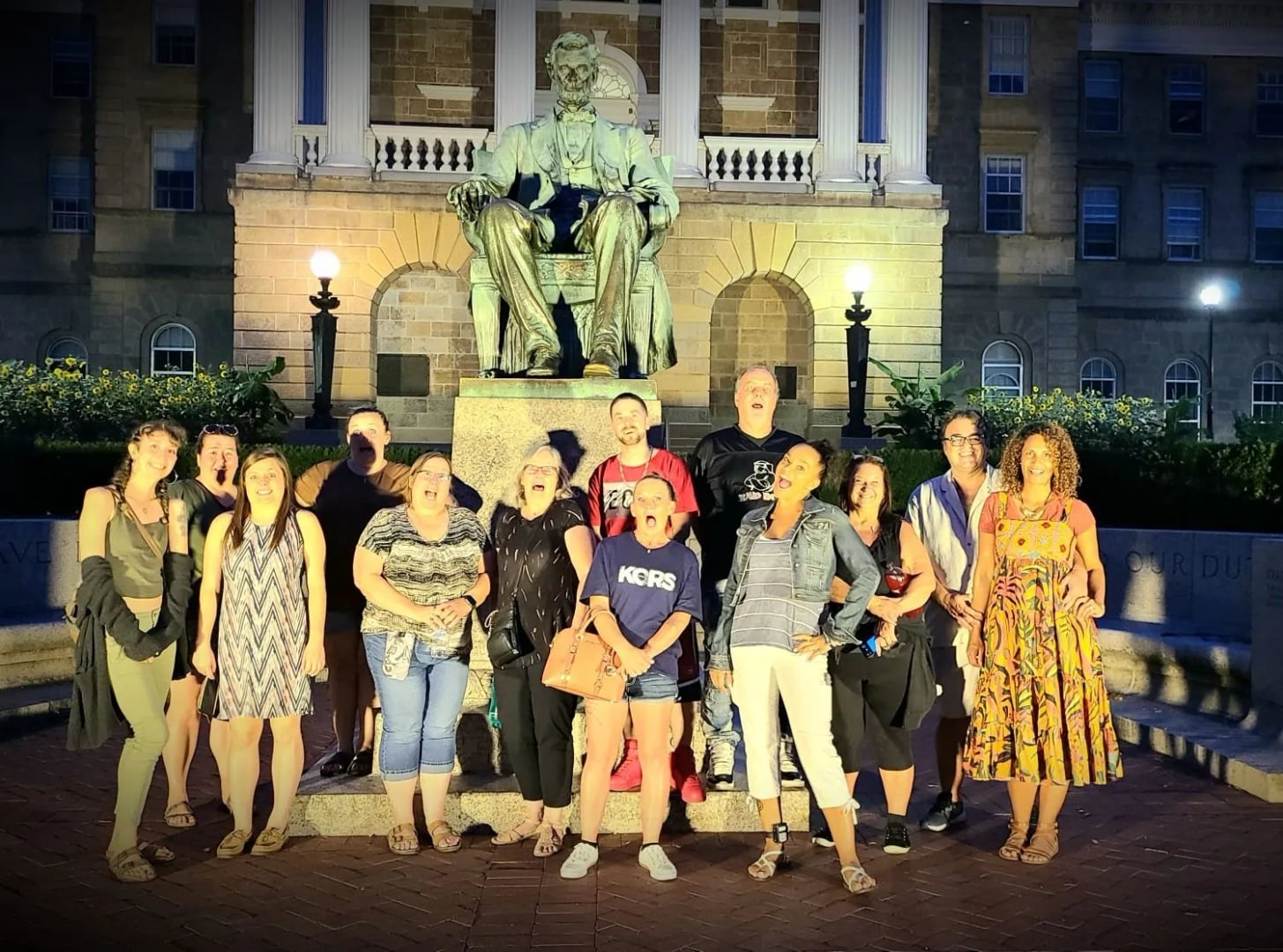
The Grand Rapids Wraiths & Witches Ghost Tour is operated by US Ghost Adventures, the multi-city tour network that runs equivalent products in Detroit, Chicago, and other markets. Tours depart from the Riverwalk Promenade at 299 Lyon Street NW, on the east bank of the Grand River. The guide is identified by a branded shirt and a hand-carried lantern.
The one-mile route is structured around six anchor properties. The Amway Grand Plaza Hotel incorporates the original Pantlind Hotel, opened in 1916, whose upper floors have generated decades of guest reports. The Michigan Bell Building and the Peck Building anchor the early-twentieth-century commercial core. The Grand Rapids Public Library, designed by Edward Tilton and opened in 1904 in a Beaux-Arts plan, is included for documented overnight reports by staff. Veterans Memorial Park covers the city's nineteenth-century militia and Civil War heritage. The St. Cecilia Music Center, opened in 1894 as one of the earliest dedicated women's music clubs in the United States, is positioned as the route's climactic stop.
The tour runs nightly year-round. Cancellation policy is free up to 24 hours before the scheduled start time per the operator's published terms. Bookings are available through the US Ghost Adventures website and through third-party platforms including Viator, GetYourGuide, and Expedia.
Sources
- https://usghostadventures.com/grand-rapids/
- https://www.michigan.org/property/grand-rapids-wraiths-and-witches-ghost-tour
- https://www.experiencegr.com/articles/post/tour-of-grand-rapids-ghostly-history/
ApparitionsPhantom footstepsCold spotsObject movementDoors opening/closingEMF anomaliesOrbs
The Amway Grand Plaza Hotel, occupying the original 1916 Pantlind Hotel structure, generates the bulk of the route's hotel-based phenomena reports — phantom footsteps in the original upper-floor corridors, occasional doors closing without contact, and intermittent guest reports of figures in early-twentieth-century clothing on the historic side of the property.
The St. Cecilia Music Center is presented as the tour's most active stop. Built in 1894 by a women's music society and still in continuous use as a performing-arts venue, the building has accumulated more than a century of after-hours staff and performer accounts: footsteps and chair movement in empty halls, instrument sounds without a player, and EMF anomalies during instrument storage and tuning. The tour's framing positions the building as a possible "portal" stop, though the operator presents this as folklore rather than as confirmed paranormal evidence.
The Peck Building, the Michigan Bell Building, the Grand Rapids Public Library, and Veterans Memorial Park each contribute supporting narratives — building-specific cold spots, library-staff reports of book movement, and park accounts tied to nineteenth-century militia history. None are presented as theatrically as the music-center stop. The cumulative effect is a downtown walk through six properties whose haunting reports are independently documented.